Stay Updated
Get the latest insights on creative testing and ad optimization delivered to your inbox.
Get the latest insights on creative testing and ad optimization delivered to your inbox.
Continue reading about this topic with these recommended articles.
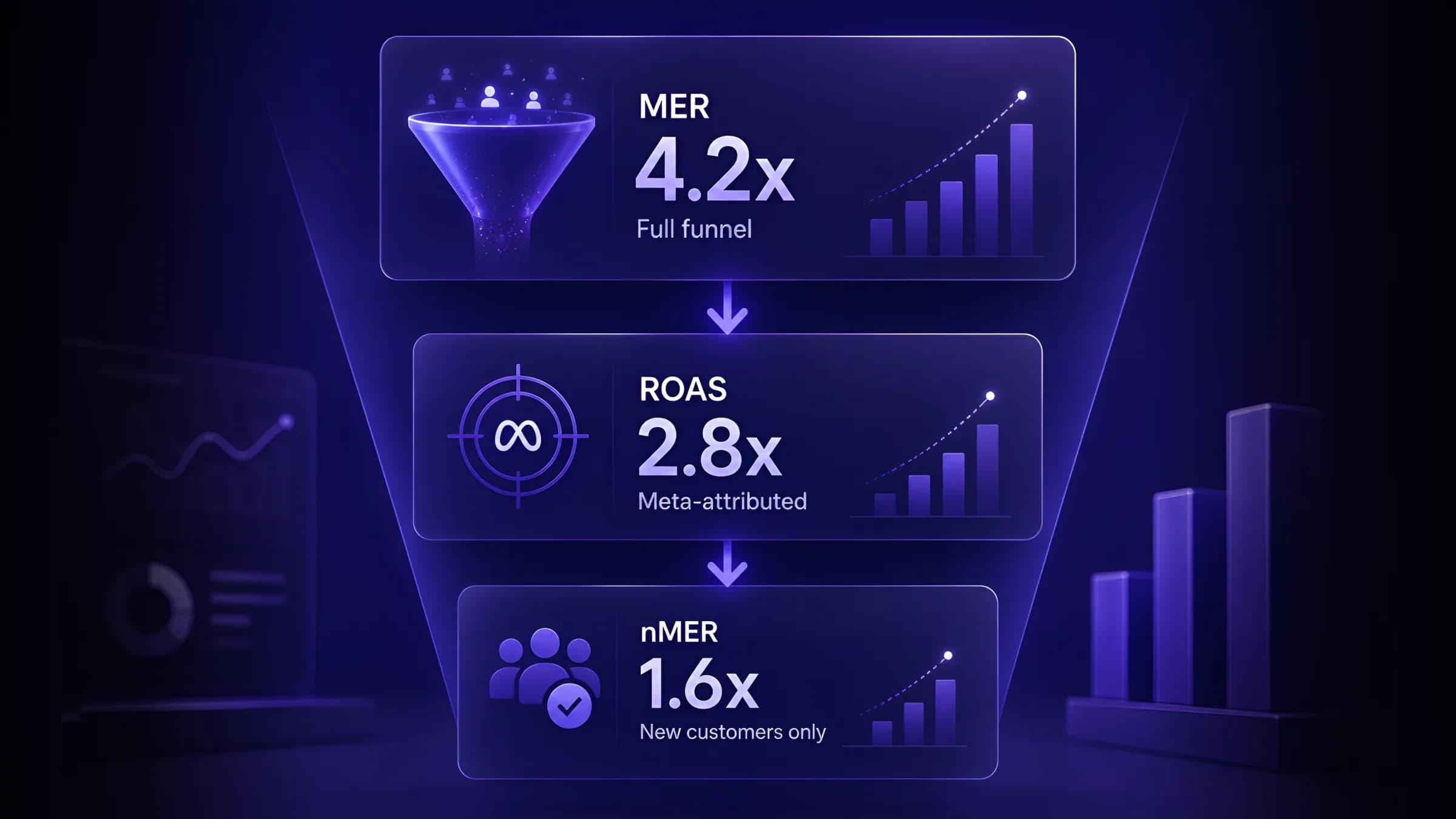
Platform ROAS, blended MER, and new-customer nMER answer different questions — and using the wrong one in the wrong meeting misallocates budget. See the three-layer stack and when to report each.

AI-powered marketing tools

A good CPA is below your break-even and inside the cited band for the same conversion event. 2026 Google and Meta lead-CPL vs ecommerce purchase CPA — and the calculator that runs the math.
AI-powered marketing tools

As Meta automates audience, placement, budget, and creative optimization, the hunt for a single winning ad is a weaker scientific unit. The better question is which creative features—hooks, proof, messengers, contexts—compound signal across delivery environments.
AI-powered marketing tools

Measure the true impact of your marketing campaigns by calculating incrementality. Understand which portion of your conversions would have happened organically versus those directly caused by your marketing efforts.

Master advanced marketing analytics through real-world scenarios focused on incrementality testing, multi-touch attribution, and cross-channel optimization. Learn to design robust measurement frameworks, analyze complex datasets, and drive actionable insights.

Calculate Marketing Efficiency Ratio (MER) metrics to evaluate overall marketing performance, attributed efficiency, and new customer acquisition. Use our free MER calculator to apply multiple MER formulas (MER, aMER, nMER), analyze key efficiency metrics, and optimize your marketing ROI with data-driven insights.
Incrementality is a scientific measurement approach that determines the true incremental value generated by a marketing activity by comparing outcomes against a statistically valid control group. Unlike basic attribution models, incrementality testing uses randomized controlled trials and sophisticated causal inference techniques to identify what would have happened without the marketing intervention, enabling marketers to understand the real marginal impact of their spending and optimize toward truly incremental growth.
Return on Ad Spend (ROAS) is a marketing performance metric that measures the revenue generated per dollar of advertising spend. Unlike ROI which considers all business costs, ROAS specifically evaluates advertising efficiency by comparing directly attributable revenue to ad spend. This metric is crucial for optimizing campaign performance, budget allocation, and overall marketing strategy.
Marketing Efficiency Ratio measures the overall effectiveness of marketing spend by comparing total revenue to total marketing costs. It provides a holistic view of marketing performance across all channels and customer types, including both direct and indirect revenue attribution. Also known as 'blended MER' since it considers all revenue rather than just attributed revenue.
Direct-to-Consumer (DTC) is a business and marketing model where companies sell products directly to end consumers, bypassing traditional retail intermediaries. This approach enables brands to own the customer relationship, control the shopping experience, and gather first-party data while typically offering better value through reduced distribution costs.
Platform ROAS overstates true impact by 20–85% depending on channel. This guide covers Meta Conversion Lift, geo holdouts, iROAS math, and the decision framework that turns lift results into budget moves.
Short answer: an incrementality test only changes budget decisions when you write one falsifiable question first, pick the right design (Conversion Lift for single-platform validation, geo holdout for cross-channel truth), run with enough power (~5,000–15,000 users per arm for typical DTC), and budget against incremental ROAS — not platform ROAS. The rest of this post is the full workflow, with channel benchmarks and the decision rules that separate measurement theater from budget moves.
Most performance teams added MER after iOS 14.5 and stopped trusting platform ROAS in isolation. That was necessary — but MER still cannot tell you whether a specific channel caused a conversion or merely claimed one. Attribution models answer "who gets credit?" Incrementality testing answers "would this have happened anyway?"
This is the first dedicated incrementality article in our Attribution & Measurement hub. It pairs with the Incrementality Testing guide and our incrementality glossary entry — not a lecture on causal inference theory, but the operational sequence finance and media teams use before reallocating six-figure budgets.
Three mechanisms inflate platform-reported performance:
The eBay experiments remain the most cited proof: when the company paused brand-keyword search ads, traffic shifted to organic listings with — users were navigating to eBay, not discovering it. Modern DTC brands see the same pattern on Meta and branded search — high platform ROAS, low incrementality.
See our incrementality glossary benchmarks for full channel ranges with sources.
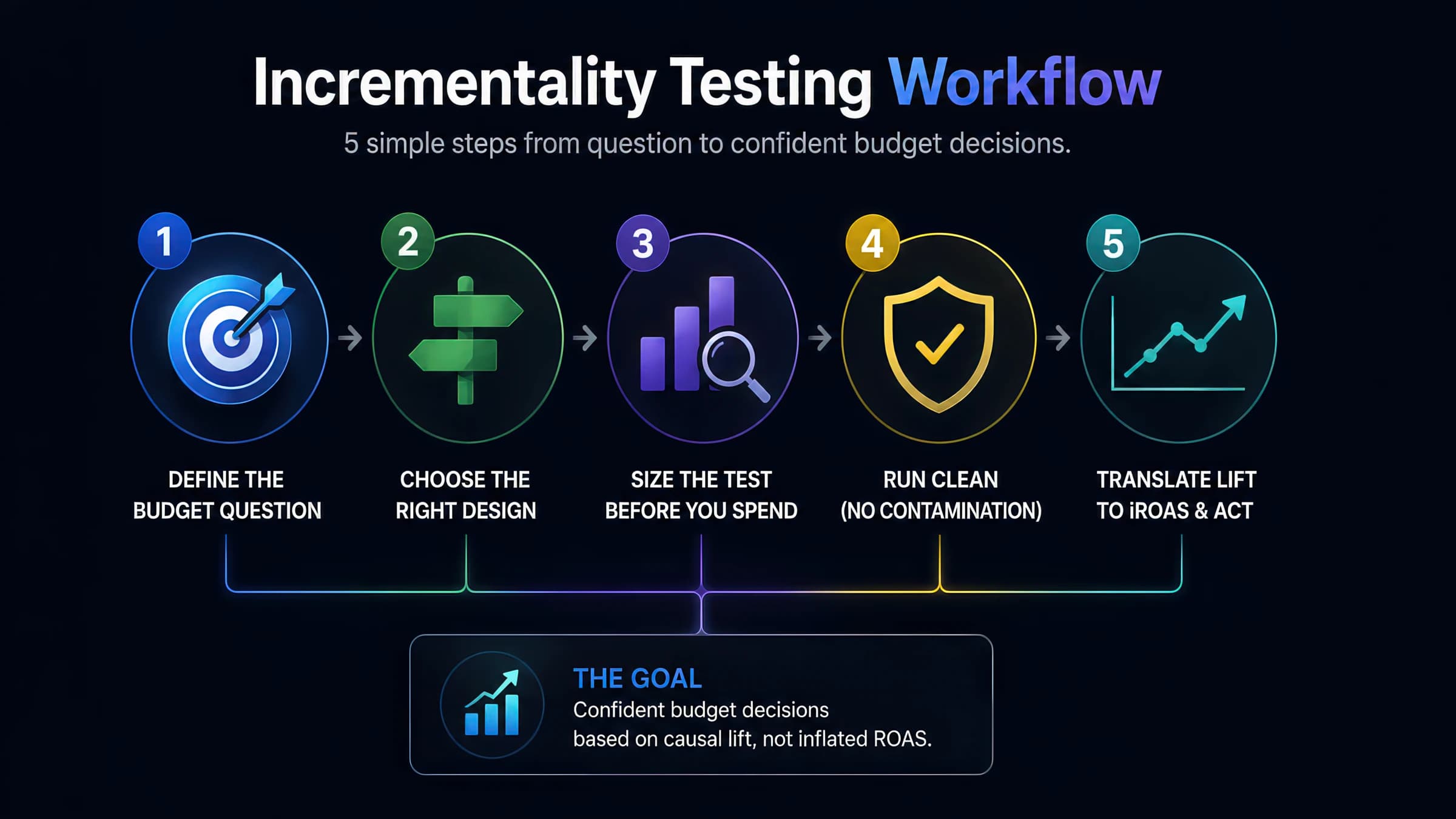
A lift study without a written question produces a number nobody acts on. Use this template:
Strong example: "If we pause Meta retargeting for 14 days, will new-customer revenue drop materially, or will those users convert via email and organic anyway?"
Weak example: "Let's run a lift study and see what happens."
The strong version tells you which test design to use, how long to run, and what result triggers a budget change. For the measurement stack context, see MER vs ROAS vs nMER.
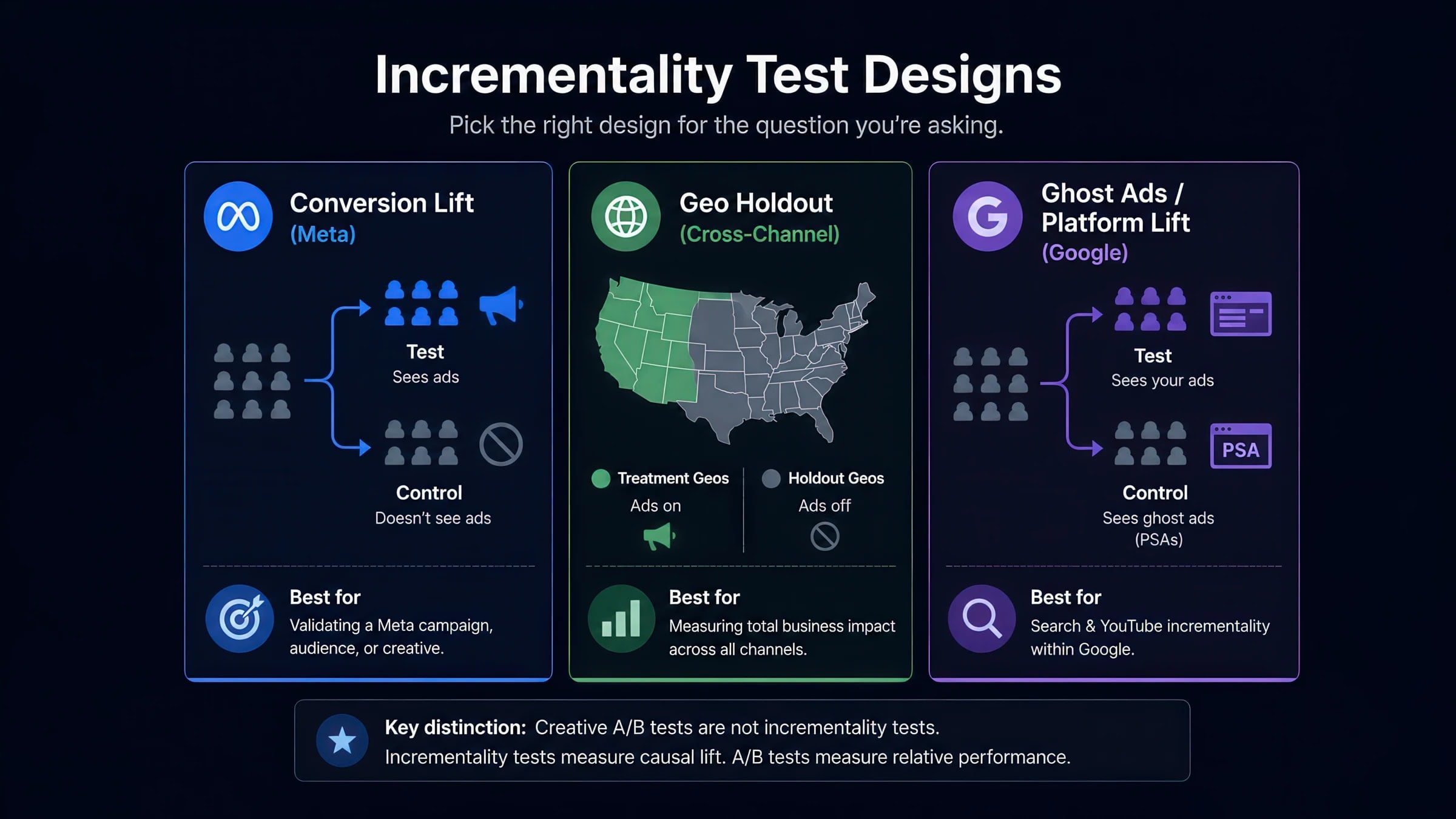
Best for: Validating a Meta campaign, audience, or creative strategy.
User-level randomization — test group sees ads, control group is withheld. Meta reports lift %, incremental conversions, and confidence intervals.
Requirements: 50–100+ weekly conversions per cell, stable campaign, 2–4 weeks, 10–20% holdout.
Best for: Total business impact across channels — organic, email, retail, and paid combined.
Critical distinction: Creative A/B tests are not incrementality tests. Both variants receive ads — you measure relative performance, not causal lift[4]. Use creative A/B testing for hook and format learning; use Conversion Lift for budget truth.
Underpowered lift tests are the silent budget killer. They return wide confidence intervals that look directionally positive but are statistically inconclusive — and teams scale anyway because platform ROAS looked good going in.
Power analysis inputs:
For typical DTC accounts, plan ~5,000–15,000 users per arm to detect a 20% lift. Below that floor, expect CIs like "+8% lift (−2% to +18%)" — directionally interesting, not budget-actionable.
Use the Marketing Incrementality Calculator to compute lift and iROAS from treatment/control results, and the A/B Significance Calculator to validate statistical significance.
The four contamination sources we see most often:
Holdout users see other ads from your account outside the test cells. Pause or exclude overlapping campaigns for the test window.
National brand campaigns, influencer posts, or TV spill into holdout markets. Document and model spillover or restrict test to regions with isolated media mix.
Budget doubles, creative refreshes, or optimization event switches invalidate before/after comparison. Hold conditions stable for the full window.
Test starts on Black Friday, ends on Cyber Monday. Control and treatment both spike — lift signal drowns in noise. Overlap windows and avoid promotional periods unless testing promo incrementality specifically.
Raw lift % is not actionable until converted to incremental economics:
Incremental ROAS (iROAS) = (Treatment Revenue − Control Revenue) / Treatment Spend
Equivalently: iROAS ≈ Platform ROAS × Incrementality %
If platform ROAS is 4.0x but incrementality is 30%, true iROAS is ~1.2x — still positive, but a fundamentally different budget conversation than "4x returns."
Prioritize where attribution is most suspicious:
Cold Meta/TikTok prospecting typically confirms rather than surprises — test there to build confidence in the methodology before tackling politically difficult channels.
Attribution and incrementality are complements, not substitutes. Attribution tells your media buyer which ad set to scale today. Incrementality tells your CMO whether the channel keeps its budget next quarter.
For the statistical foundations behind significance thresholds, see Statistical Noise in Marketing. For creative-level diagnostics after a lift study confirms incrementality, see Creative Feature Models.
Incrementality testing is not a quarterly report for the analytics team — it is the check that keeps budget decisions honest. Run it before you cut branded search, before you double retargeting, and before you believe any platform dashboard that shows 6x ROAS.
Users who would have purchased via direct, email, or organic search click a paid ad instead. The platform takes credit; the purchase was not incremental.
Meta, Google, TikTok, and Klaviyo each claim 100% credit for the same conversion. Summing platform ROAS overstates portfolio performance by 30–50%.
7-day view attribution credits conversions to impressions users barely noticed. Retargeting pools amplify this effect.
Typical incrementality (median ~65%)
Typical incrementality (median ~25%)
Typical incrementality (median ~15%)
Budget question template: "If we [increase/decrease/pause] [channel/campaign/audience], will [business metric] change by [expected direction], or are we mostly capturing demand that would convert anyway?"
Reading inconclusive results: A wide confidence interval that crosses zero is not a "soft yes." It means the test could not distinguish real lift from noise. Extend duration, increase holdout, or accept that the channel's incrementality at your spend level is unknowable without more data.
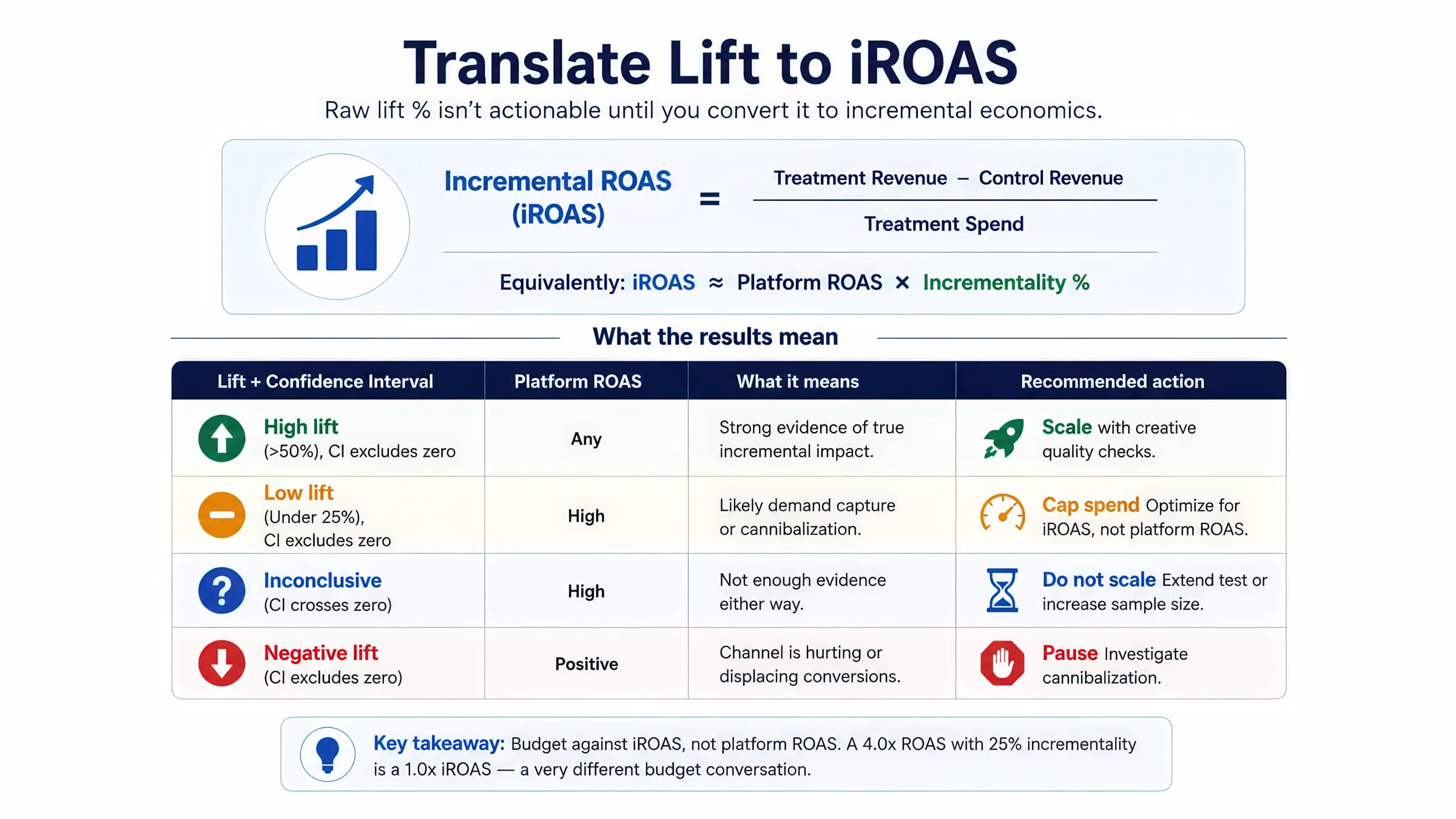
Lift + CI | Platform ROAS | Recommended action |
|---|---|---|
| High (>50%), CI excludes zero | Any | Scale with creative quality checks |
| Low (under 25%), CI excludes zero | High | Cap spend; optimize for iROAS not platform ROAS |
| Inconclusive (CI crosses zero) | High | Do not scale on attribution; extend test |
| Negative lift |
Weekly: MER + blended CAC (portfolio health) → Daily: Platform ROAS/CPA (in-channel optimization) → Quarterly: Incrementality tests on disputed channels (budget truth)
Matched markets go dark while treatment markets run ads. Compare sales using GeoLift or CausalImpact with pre-period trend adjustment.
Requirements: Geo-tagged conversion data, 6+ matched pairs, 4+ weeks, no national campaign leakage into holdout geos.
Best for: Search and YouTube incrementality within Google's ecosystem.
Control group sees unrelated PSAs instead of your ads — preserving auction dynamics while withholding genuine exposure.
Priority test: Branded search cannibalization — the channel most consistently over-credited.
| Positive |
| Pause; investigate cannibalization |

