Incrementality Testing: How to Measure True Marketing Lift
A practical guide to incrementality testing — geo holdouts, Meta Conversion Lift, ghost ads, and iROAS math — with sample-size guidance, channel benchmarks, and budget decision frameworks.
Quick takeaway
Platform ROAS overstates true impact by 20–85% depending on channel. Incrementality testing isolates causal lift with holdouts — run it before you reallocate six-figure budgets.
Why Platform ROAS Is Not Enough
Attribution tells you who got credit. Incrementality tells you what marketing actually caused.
After iOS 14.5, most performance teams added MER and blended CAC to their dashboards — metrics that do not rely on platform attribution windows. That solved the credit-allocation problem. It did not solve the causality problem.
A channel can show strong platform ROAS while contributing near-zero incremental revenue. The eBay field experiments (Blake, Nosko & Tadelis) remain the canonical example: pausing paid search recovered ~99.5% of traffic through organic listings, with no measurable sales impact for brand-keyword campaigns — users were navigating, not discovering.
Incrementality testing is the validation layer that answers: *would this conversion have happened without the ad?* Without that answer, budget decisions rest on attribution models that systematically over-credit retargeting, branded search, and view-through windows.
| Question | Attribution / ROAS | Incrementality testing |
|---|---|---|
| Who gets credit? | ✓ Primary use | — |
| Would it happen anyway? | — | ✓ Primary use |
| In-platform optimization | ✓ Daily | Limited |
| Budget allocation | Risky alone | ✓ Gold standard |
| Cost to run | Free (built-in) | Holdout revenue + tooling |
Meta retargeting incrementality
~15–35%
Directional range; varies widely by account and audience overlap
Meta cold prospecting
~55–80%
Typically the cleanest incrementality signal — still account-dependent
Branded search
~10–20%
Direction (low) replicated by the eBay paid-search experiments
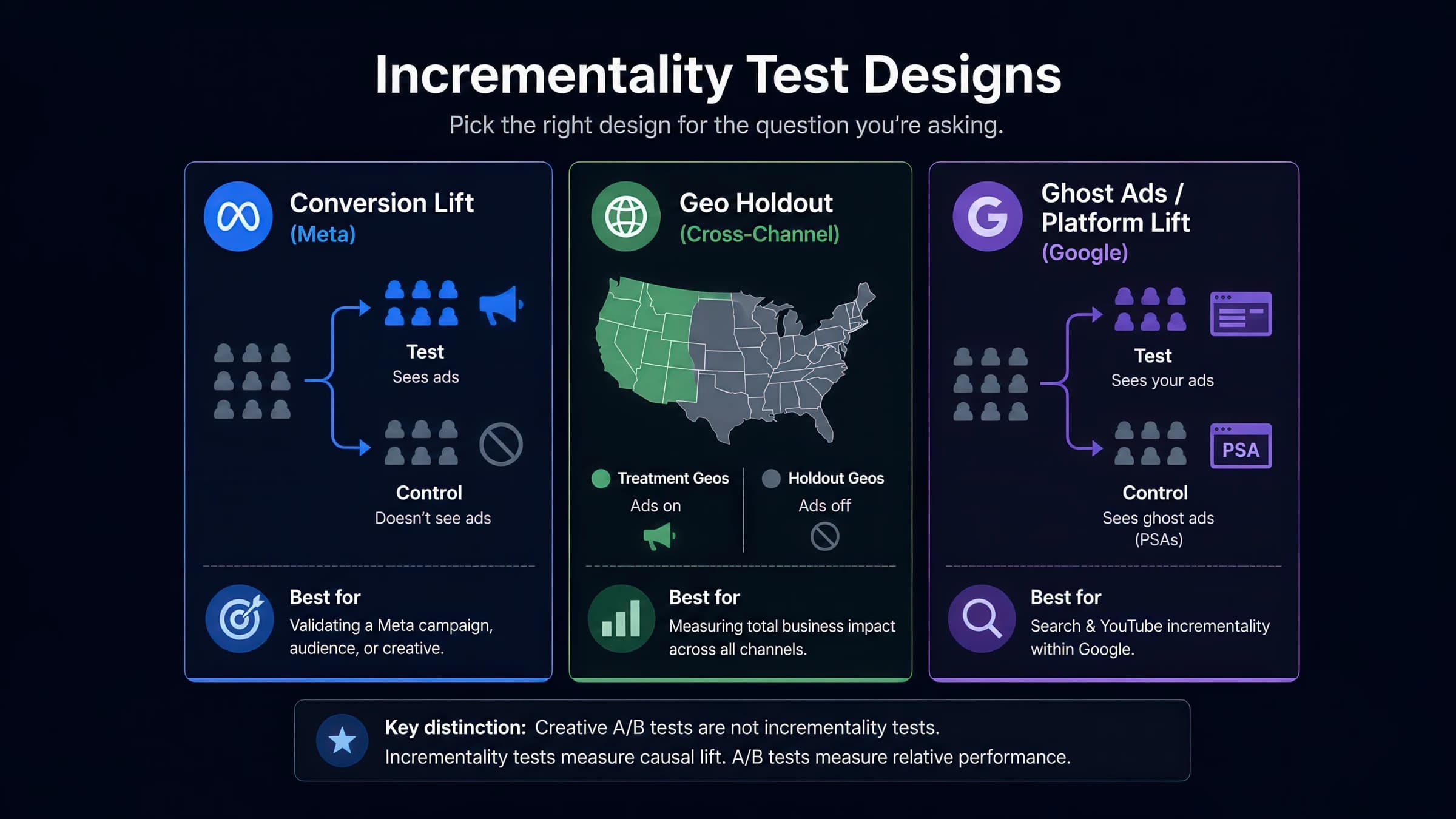
Four Incrementality Test Designs
Match the design to the budget question — not every test requires a geo holdout.
1. Platform Conversion Lift (Meta, Google, TikTok)
The platform splits your eligible audience into test (exposed) and control (withheld) groups using user-level randomization. Meta's Conversion Lift studies measure on-site conversions via Pixel, Conversions API, or offline events. Google offers Ghost Ads and geo experiments; TikTok provides Marketing Mix and lift products for larger accounts.
Best for: Validating a specific campaign, audience, or creative strategy on one platform.
Requirements: Stable campaign conditions, 50–100+ weekly conversions per cell, Conversions API recommended, 2–4 week duration, 10–20% holdout typical.
Limitation: Measures in-platform lift only — does not capture halo to organic, email, or retail unless paired with warehouse data.
2. Geo holdout tests
Matched geographic regions receive ads (treatment) while holdout regions go dark (control). Compare post-period sales or conversions between regions, adjusting for pre-period trends using tools like Meta GeoLift or Google CausalImpact.
Best for: Cross-channel budget decisions, offline impact, total business lift.
Requirements: Geo-tagged conversion data, 6+ matched market pairs, 4+ weeks minimum, no national campaigns leaking into holdout geos.
3. Switchback tests
Alternate ad on/off periods within the same geography — e.g. ads run Mon–Wed, dark Thu–Sat, repeated for several weeks. Useful when matched markets are unavailable.
Best for: National brands, short purchase cycles, channels without platform lift products.
Caution: Carryover effects between periods require careful modeling.
4. Audience / intent holdouts
Withhold ads from a percentage of branded-search queries or retargeting pools to measure cannibalization directly.
Best for: Branded search ROI, retargeting incrementality, Performance Max validation.
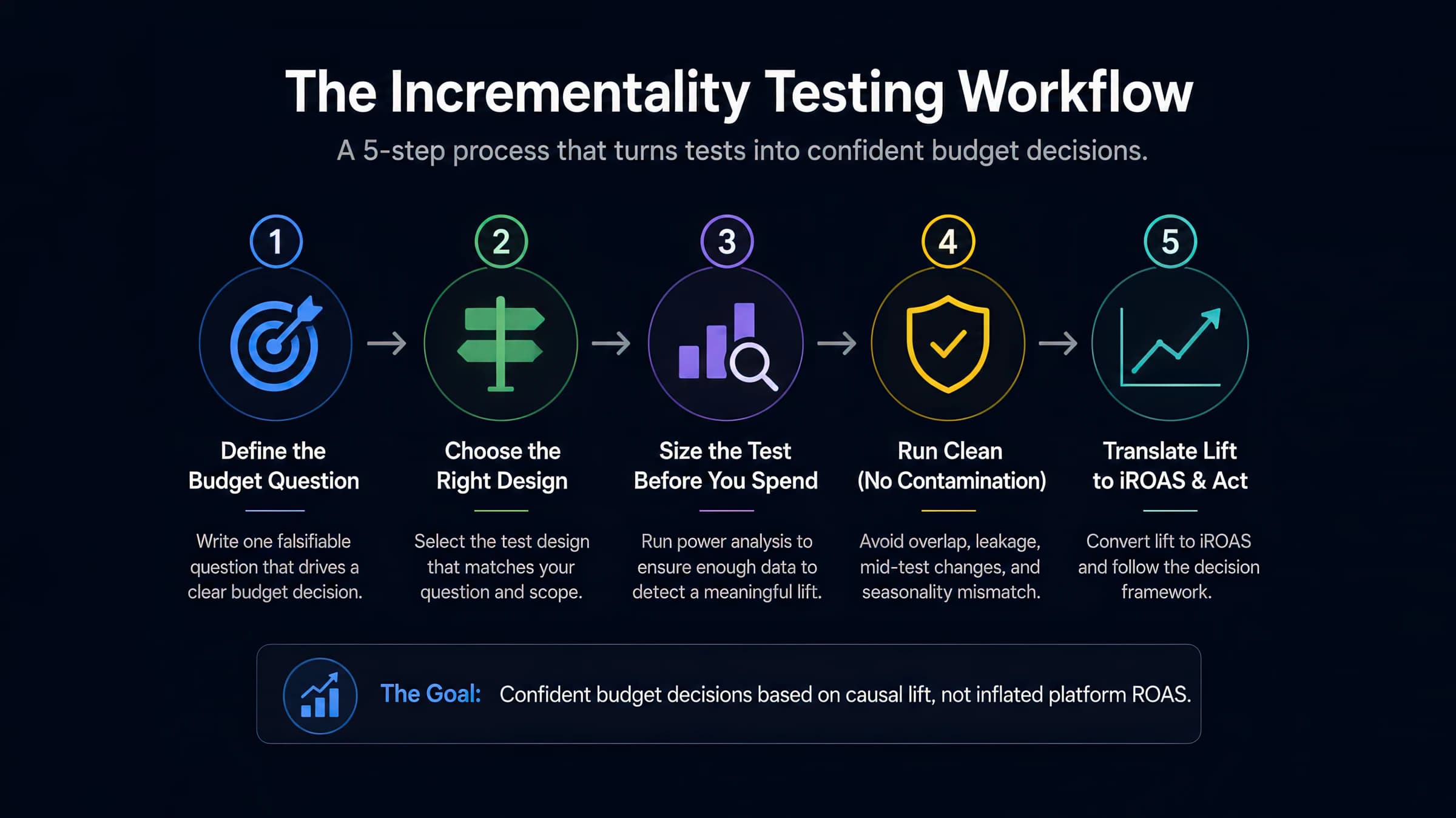
Running a Meta Conversion Lift Study
Step-by-step workflow for the most accessible incrementality test in paid social.
- 1
Write one business question
Example: "Does our Meta prospecting campaign drive incremental purchases, or mostly capture users who would have converted via organic/direct?" Isolate one strategy — not five simultaneous changes.
- 2
Choose single-cell or multi-cell
Single-cell measures one campaign's lift. Multi-cell compares strategies (e.g. ASC with dynamic overlays vs without) — only the tested strategy should differ between cells.
- 3
Set holdout and duration
10–20% holdout balances signal strength with foregone revenue. Run 2–4 weeks on stable campaigns — not new launches still in learning phase.
- 4
Eliminate contamination
Pause overlapping campaigns targeting the same audience outside the test cells. Holdout users who see other Meta ads from your account invalidate the control.
- 5
Read lift, CI, and iROAS
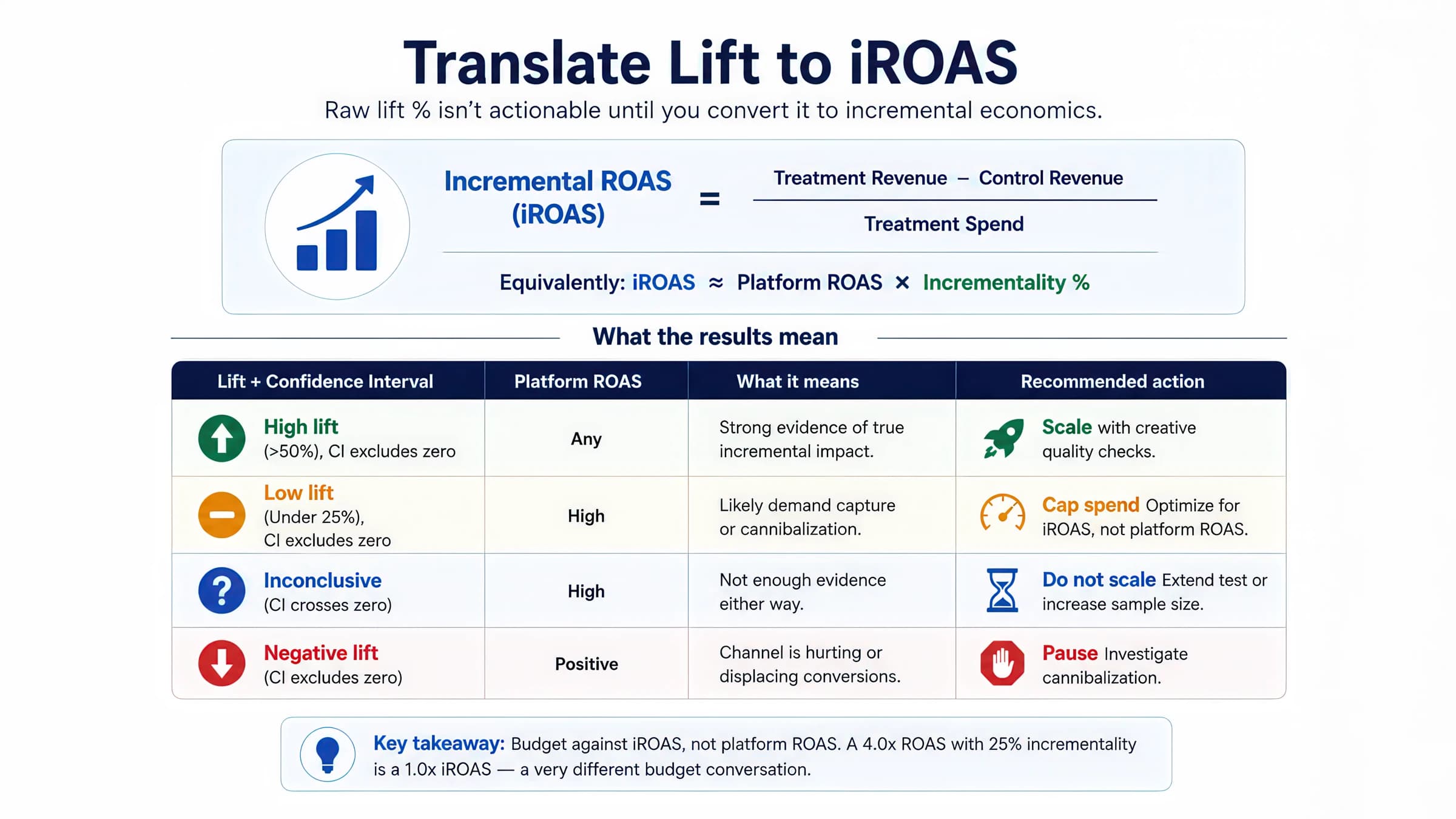
Meta reports lift %, incremental conversions, and confidence intervals. Translate to iROAS: (Treatment Revenue − Control Revenue) / Treatment Spend. Compare to platform ROAS — the gap is your attribution tax.
Free Tool
Marketing Incrementality Calculator
Compute incremental lift %, incremental conversions, and iROAS from treatment and control results.
Sample Size and Statistical Power
Underpowered lift tests are the most expensive mistake — they look directional but change nothing.
Power analysis inputs:
- Baseline conversion rate — control group CVR or sales rate
- Minimum detectable effect (MDE) — smallest lift worth acting on (often 10–20% relative)
- Holdout share — 10–20% typical; larger holdouts tighten confidence intervals but cost revenue
- Significance level (α) — 0.05 standard
- Power (1−β) — 0.80 standard
For typical DTC accounts, plan ~5,000–15,000 users per arm to detect a 20% lift at 95% confidence. Accounts under ~$50K/month Meta spend often cannot run a properly powered geo test — start with platform Conversion Lift on your largest audience instead.
Reading results: A point estimate of +12% lift with 95% CI of +4% to +20% is actionable. +8% lift with CI of −2% to +18% is inconclusive — usually underpowered, not negative.
Free Tool
A/B Test Significance Calculator
Validate whether observed lift between treatment and control groups reaches statistical significance.
From Lift Results to Budget Decisions
A lift number only matters when it changes how you allocate spend.
The measurement stack
- MER / blended CAC — weekly portfolio health (macro)
- Platform ROAS / CPA — in-channel optimization (micro)
- Incrementality tests — quarterly validation of disputed channels (truth)
| Lift result | Platform ROAS | Action |
|---|---|---|
| High incrementality (>50%) | Any | Scale cautiously; validate creative quality separately |
| Low incrementality (<25%) | High reported ROAS | Cut or cap spend; price against iROAS not platform ROAS |
| Inconclusive CI | High reported ROAS | Extend test or increase holdout — do not scale on attribution alone |
| Negative lift | Positive ROAS | Pause and investigate cannibalization |
Channels to test first
Prioritize the channels where attribution is most suspicious: branded search, retargeting, Performance Max, and broad awareness video. Cold prospecting on Meta/TikTok typically shows the highest incrementality — tests there confirm rather than surprise.
Key Takeaways
- Attribution optimizes inside a channel; incrementality decides whether the channel keeps its budget
- Run Conversion Lift quarterly on top Meta audiences; geo holdouts annually for total business impact
- Budget against iROAS, not platform ROAS — especially for retargeting and branded search
- One inconclusive test is one data point — patterns across multiple tests matter more
Free Tool
MER Calculator
Track blended MER alongside incrementality results — MER is the macro health signal; iROAS is the channel truth check.
Frequently Asked Questions
Related Tools & Guides

Incrementality Calculator
Measure the true impact of your marketing campaigns by calculating incrementality. Understand which portion of your conversions would have happened organically versus those directly caused by your marketing efforts.

A/B Test Significance Calculator
Make data-driven decisions with our A/B test significance calculator. Analyze test results with statistical rigor, determine confidence levels, and get actionable recommendations for test duration and sample size requirements.

MER Calculator
Calculate Marketing Efficiency Ratio (MER) metrics to evaluate overall marketing performance, attributed efficiency, and new customer acquisition. Use our free MER calculator to apply multiple MER formulas (MER, aMER, nMER), analyze key efficiency metrics, and optimize your marketing ROI with data-driven insights.
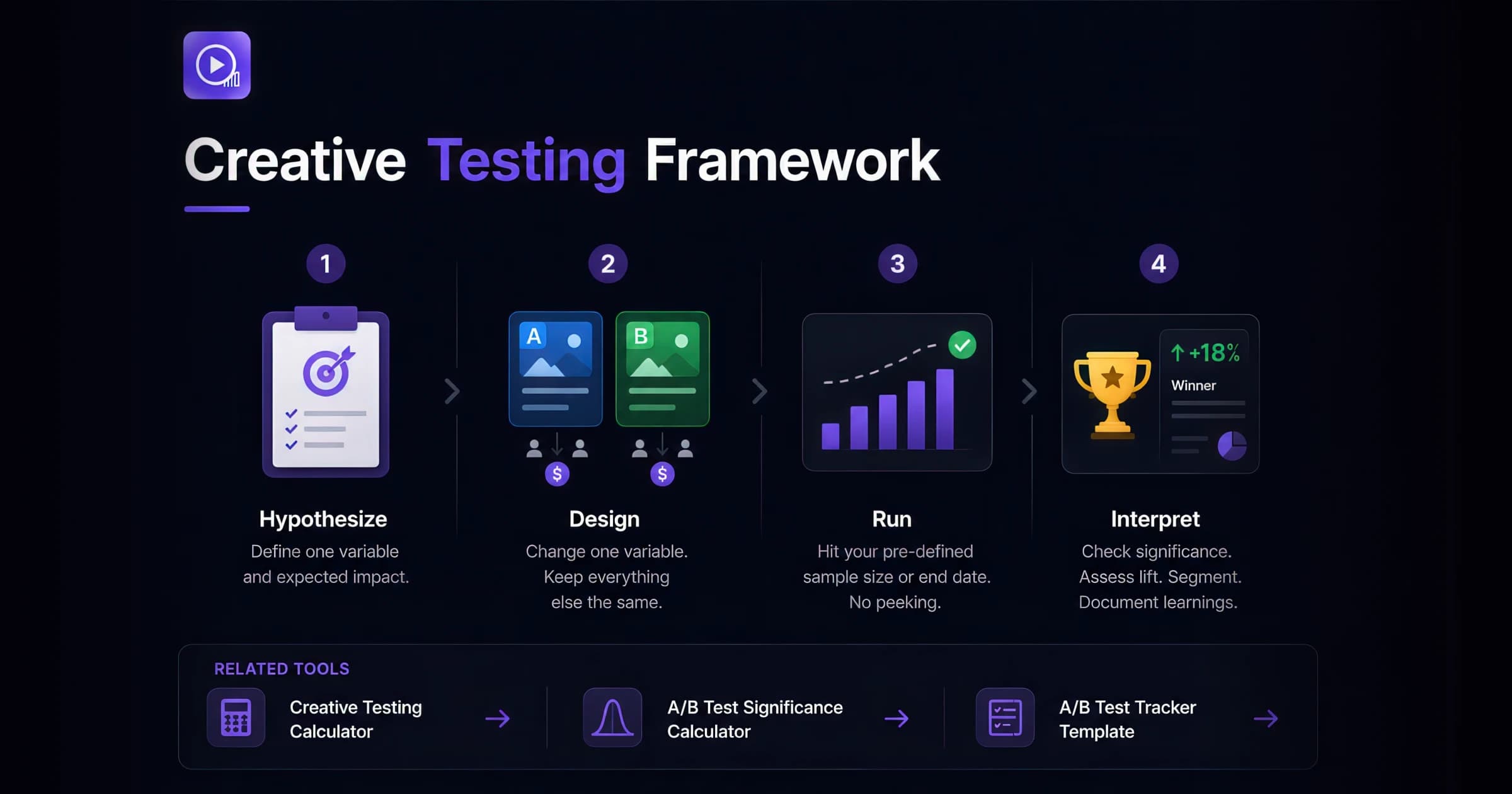
The Creative Testing Framework: How to Run Rigorous Ad Tests
A complete framework for designing, running, and interpreting paid social creative tests — from hypothesis formation through statistical significance, with sample-size guidance and common pitfalls to avoid.
