Stay Updated
Get the latest insights on creative testing and ad optimization delivered to your inbox.
Get the latest insights on creative testing and ad optimization delivered to your inbox.
Continue reading about this topic with these recommended articles.
Meta only flags creative fatigue after cost per result doubles. Catch it 1–2 weeks earlier with frequency, CTR, and CPM thresholds — plus a worked example, detection checklist, and refresh-cadence framework.

AI-powered marketing tools

As Meta automates audience, placement, budget, and creative optimization, the hunt for a single winning ad is a weaker scientific unit. The better question is which creative features—hooks, proof, messengers, contexts—compound signal across delivery environments.
AI-powered marketing tools
Master the art of targeted ad creative with proven strategies for crafting personalized, high-converting ads across different audience segments, funnel stages, and demographics.
AI-powered marketing tools

Grade your ad creatives and get actionable recommendations for improvement. This creative quality grader tool evaluates key elements like visual design, messaging, CTAs, accessibility, and platform optimization to help you create high-performing ads across Facebook, Instagram, TikTok, and YouTube. Get detailed scores and personalized tips to optimize your creative strategy.

Test your media buying knowledge with practical questions based on Meta Blueprint, TikTok Ads Manager, and YouTube Ads certifications. Get personalized recommendations to improve your campaign performance.
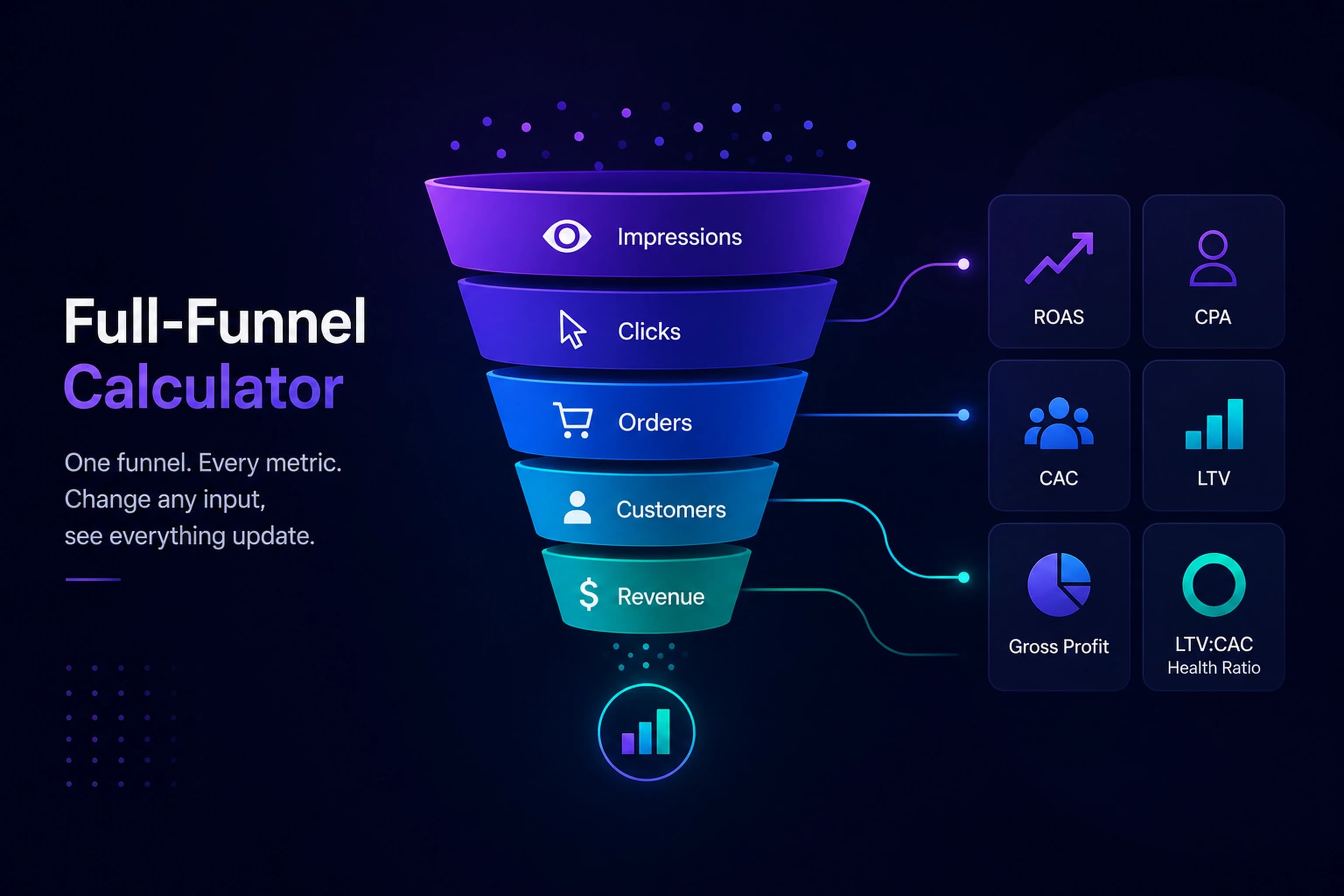
Model your entire paid-media funnel — impressions, CPM, CTR, CVR, and AOV — and instantly see ROAS, CPA, CAC, and LTV. Change any input to watch every downstream metric update, and gauge unit economics with an LTV:CAC health ratio.
Creative rotation is the systematic practice of alternating between multiple pre-tested ad variations based on performance data and audience response patterns. This approach uses automated rules and performance thresholds to optimize the frequency and sequencing of different creative executions, preventing creative fatigue while maintaining campaign effectiveness. Unlike simple ad scheduling, creative rotation incorporates performance feedback loops to dynamically adjust rotation patterns.
Click-Through Rate (CTR) measures the ratio of clicks to impressions for a digital advertisement, email, or other clickable content. It's a fundamental metric for evaluating creative relevance, audience targeting quality, and overall ad effectiveness in driving user engagement. CTR varies significantly by format, placement, and channel, making context crucial for performance evaluation.
Creative strategy is the foundational framework that guides creative development, execution, and optimization across campaigns. It aligns creative decisions with business goals, audience insights, and brand positioning while establishing clear guidelines for messaging, visual identity, and creative testing approaches. This strategic layer ensures creative work drives measurable outcomes rather than just aesthetic appeal.
A value proposition is a clear articulation of the tangible results a customer gets from using a product or service. It focuses on the specific problems solved, benefits delivered, and unique advantages offered compared to alternatives. An effective value proposition demonstrates deep understanding of customer needs while differentiating the offering in meaningful ways that resonate with the target audience.
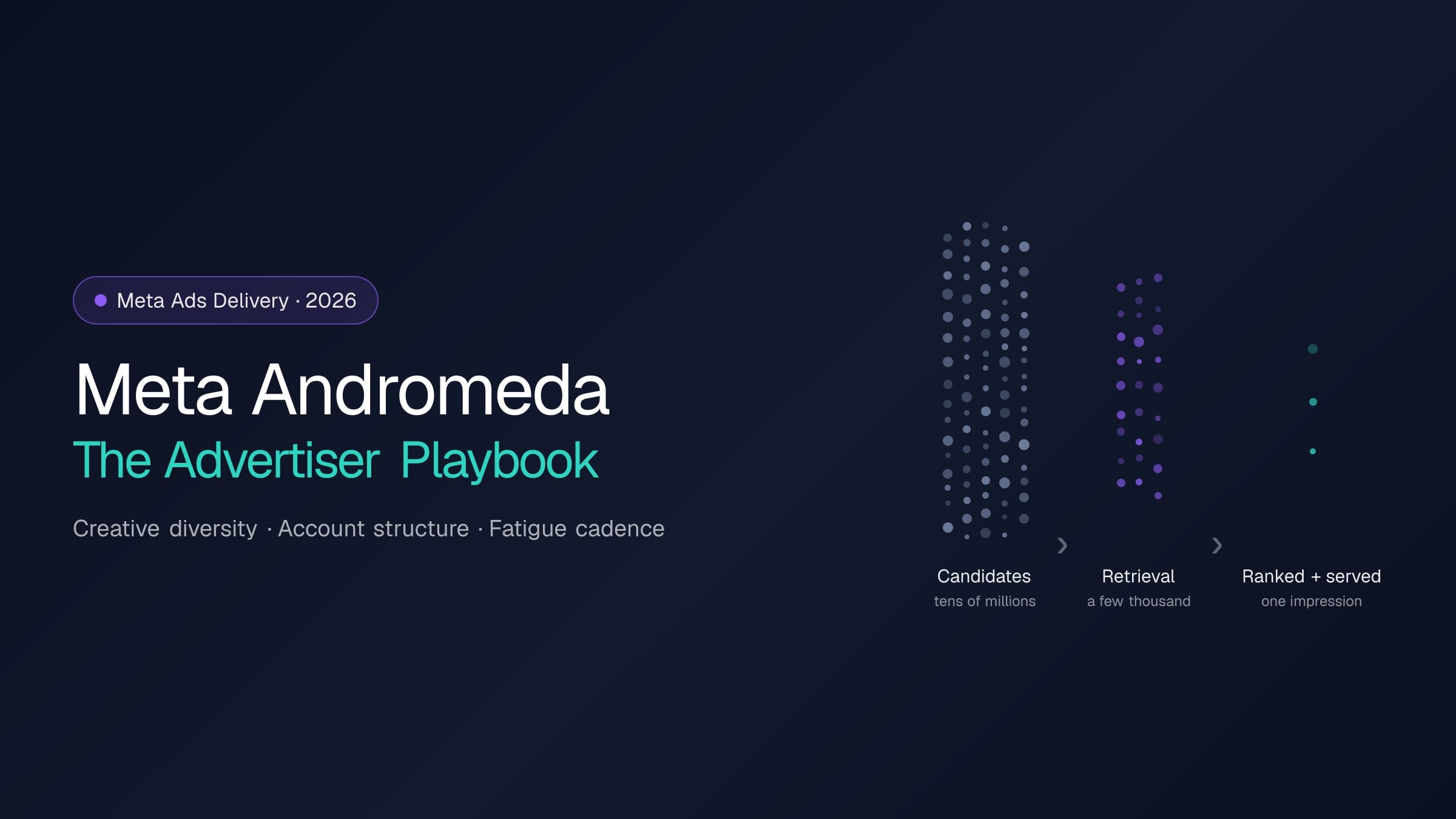
Andromeda rebuilt the retrieval stage of Meta's ads delivery; GEM and the Adaptive Ranking Model rebuilt ranking. Here is what actually changes for an operator: what to feed the system, how to structure the account, and how to run creative rotation — with every platform claim cited to Meta's own disclosures.
Short answer: Meta rebuilt ads delivery around large AI systems — Andromeda rebuilt the retrieval stage that picks a few thousand candidate ads out of tens of millions, and GEM plus the Adaptive Ranking Model rebuilt the ranking stack behind it. None of it is a setting you can toggle. What you control is what the system retrieves from: how many genuinely distinct creative concepts exist in your account, how cleanly the account is structured, and how deliberately you rotate fatigued concepts out. This post is the operational playbook for those three levers — with every platform claim footnoted to Meta's own engineering disclosures or documentation, and an explicit section on the numbers that do not exist (there is no "creative similarity score" in Ads Manager, whatever a SERP full of confident percentages implies).
A scoping note before the mechanics: this is the operational companion to our essay. That piece argues the measurement case — why the "winning ad" is a weak unit of learning once delivery is automated. This one assumes you buy the argument and answers the day-to-day question: what do you actually do differently in an account now?
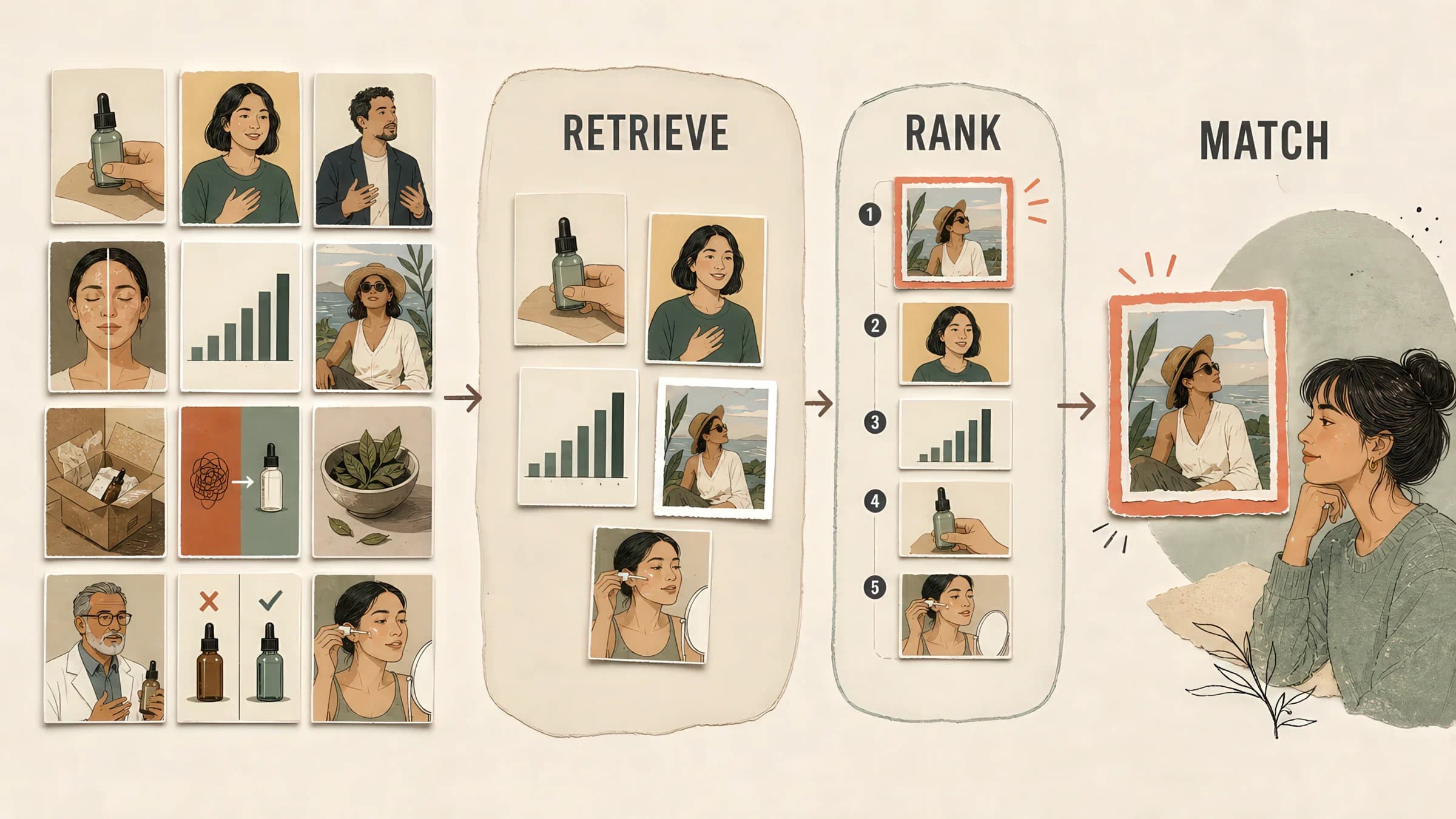
Meta's ads delivery is a multi-stage recommendation system. Before an auction ever happens, the system has to narrow the field: retrieval selects, in Meta's words, "from tens of millions of ad candidates into a few thousand relevant ad candidates," which the ranking models then score for the specific person and context.
Andromeda is Meta's redesign of that retrieval stage, announced in December 2024 and deployed across Facebook and Instagram. The published results: a +6% recall improvement in the retrieval system, a +8% ads quality improvement on selected segments, and a roughly 10,000× increase in model capacity for personalization at that stage. In plain terms: the first gate your ad has to pass became dramatically better at matching specific ads to specific people.
Andromeda did not arrive alone. Two later disclosures fill in the ranking side of the same modernization:
GEM — Meta's "Generative Ads Model" — is an LLM-inspired foundation model for ads recommendation, trained across thousands of GPUs; Meta reports its launch “delivered a 5% increase in ad conversions on Instagram and a 3% increase in ad conversions on Facebook Feed in Q2”. The Adaptive Ranking Model, disclosed in March 2026, serves ranking models at trillion-parameter scale within roughly 100-millisecond latency bounds by routing each request to the right level of model complexity, with a reported +3% ad conversions and +5% for targeted users after its Instagram launch.
And the direction of travel is explicit: Reuters, citing the Wall Street Journal, reported in June 2025 that Meta aims to let brands fully create and target ads with AI by the end of 2026 — provide a product image and a budget, and the system generates the creative, picks the audience, and suggests spend[4].
Two facts from Meta's own disclosure do the work here.
First, the retrieval stage is now personalized at enormous capacity — the 10,000× model-capacity increase exists specifically so retrieval can make finer-grained distinctions about which ads suit which person and context[1].
Second, Meta states the goal in one sentence: "Increased ad diversity can improve people's experience with ads and drive better advertiser outcomes"[1]. The same post notes the supply side exploding: more than a million advertisers used Meta's generative AI tools to create over 15 million ads in a single month[1].
Put those together and the operational inference is hard to avoid — and to be clear, this next step is our interpretation, not a Meta quote: a retrieval system built to match distinct ads to distinct people can only exploit distinctiveness you actually give it. A portfolio of ten near-identical variations occupies one point in the system's map of your account; ten genuinely different concepts — different angles, formats, and messengers — occupy ten. This was always decent creative strategy. What changed is that the delivery infrastructure on the other side is now explicitly engineered to use it.
That inference does not stand on the engineering blog alone. Meta's own advertiser-facing best-practice framework — Performance 5 — has creative diversification as a named pillar, alongside account simplification, automation, data quality, and results validation[5]. The engineering stack and the advertiser guidance point the same direction.
Four moves, in priority order. None of them require new spend — they require reallocating production and analysis effort you are already paying for.
The unit that matters is the concept — a distinct combination of hook, value proposition, proof mechanism, and messenger — not the asset count. Resizing one video into three placements and swapping two headlines produces five ads and one concept.
Asset count is not portfolio breadth.
Same testimonial video in 1:1, 4:5, and 9:16. Same hook with three background colors. Same claim read by two different creators. New montage of last quarter's winner.
One concept, many files — the portfolio still occupies a single point.
A pain-led demo, a curiosity-gap UGC piece, a quantified-outcome static, a founder-story video, an objection-handling comparison. Different hooks, proof, and messengers per concept.
Meta's Performance 5 guidance frames diversification on exactly these two axes — different creative concepts and different formats[5]. The practical brief: enumerate the distinct buyer motivations in your funnel, and make sure each one has at least one concept that speaks to it natively. Our creative diversification guide walks the production side of that exercise; ad variations that only change surface execution belong within a proven concept, not instead of new ones.
Account simplification is the first item in Meta's Performance 5, before any creative advice[5]. The logic is signal concentration: delivery systems learn per optimization unit, and an account fragmented into a dozen overlapping ad sets splits the conversion signal the models learn from into thin, noisy slices.
In the Andromeda era this compounds with the diversity point: consolidation and diversification are the same strategy viewed from two sides. Consolidated structure gives the system one strong learning surface; a diverse concept portfolio gives it meaningful choices within that surface. The failure mode to retire is the old one — expressing every audience hypothesis as another duplicated ad set with the same creative inside. Express hypotheses as concepts, and let delivery do the routing it is now demonstrably built for.
Nothing about Andromeda repeals creative fatigue: repeated exposure still decays engagement, and Meta's official Ads Manager statuses — Creative limited and Creative fatigue — still key off cost-per-result deterioration against your own past ads, with the full-fatigue label firing only once cost per result has doubled[6]. Those statuses are lagging confirmations, not alarms; the leading-indicator thresholds, the worked math, and the refresh-cadence framework live in our dedicated creative fatigue playbook, and this post will not duplicate them.
What the Andromeda era changes is the replacement discipline:
The question is not 'is this ad tired?' but 'which concept is saturating, and what genuinely new concept replaces it?' A re-crop of the fatigued winner hands the retrieval system the same candidate in a new file.
If every refresh is produced reactively after the status appears, you ship near-duplicates under deadline pressure. A monthly cadence of net-new concepts — sized to your spend and audience — is what makes honest diversity sustainable.
When a concept fatigues, the durable question is which of its features (hook, proof, messenger, context) saturated and which still carry. That is the feature-level ledger the companion essay builds; it is what stops a fatigue event from deleting a quarter of learning.
The paradox of the automation era: as delivery gets smarter, naive readouts get less trustworthy. When the system routes each ad to the pocket of people it predicts will respond, the performance gap between two ads reflects creative quality and routing — which is precisely why single "winner" declarations mislead, and why the durable unit of learning is the recurring creative feature, not the asset[7].
Operationally: tag every concept's features when it ships (a spreadsheet is fine); when you need a clean causal read on a specific contrast, run it as a deliberate experiment — our guide to running a Meta creative test that proves something covers the design, and the creative testing calculator tells you whether you have the volume to support the decision before you start. And close the loop Meta's own framework closes: Performance 5's remaining pillars — data quality and results validation — are the unglamorous half of the playbook[5]. A personalized delivery system optimizing toward a mis-instrumented conversion event personalizes toward the wrong thing at scale.
Content about Andromeda is crowded with confident, specific figures. Before trusting any of them — including ours — check the source. As of this writing:
None of this weakens the playbook; it defines its edges. The moves above stand on what is actually documented — Meta's disclosed architecture, its published best practices, and its own statement that ad diversity drives advertiser outcomes — plus clearly-labeled operational inference. When a claim's only source is repetition, we cut it. We recommend the same standard for anything your team reads about ads delivery in 2026, this post included.
The creative feature models essay is the measurement-layer companion to this playbook. The creative fatigue playbook owns the detection thresholds and refresh math this post pointed at. If you are auditing an account against the moves above, the creative quality grader is a fast structured pass over hooks, formats, and proof, and the Advantage+ glossary entry covers the campaign-automation layer that sits on top of the delivery stack described here.
System | Stage | What Meta disclosed | Reported results |
|---|---|---|---|
| Andromeda (Dec 2024) | Retrieval | Next-gen personalized retrieval engine selecting a few thousand candidates from tens of millions | +6% retrieval recall; +8% ads quality on selected segments; ~10,000× model capacity |
| GEM (Nov 2025) | Ranking foundation | LLM-inspired ads foundation model trained across thousands of GPUs; transfers knowledge into serving models | Meta reports a 5% increase in ad conversions on Instagram and 3% on Facebook Feed in Q2 |
| Adaptive Ranking Model (Mar 2026) | Ranking inference | Request-aware routing that serves trillion-parameter-scale ranking under ~100 ms latency bounds | Meta reports +3% ad conversions and +5% CTR for targeted users after the Instagram launch |
What Andromeda is not: a campaign setting, a bid strategy, a new attribution model, or a metric. There is nothing to enable and nothing to opt out of. If a checklist tells you to "turn on Andromeda," close the tab.


Each concept is a distinct candidate the system can route to a different audience pocket.

