Stay Updated
Get the latest insights on creative testing and ad optimization delivered to your inbox.
Get the latest insights on creative testing and ad optimization delivered to your inbox.
Continue reading about this topic with these recommended articles.
Meta only flags creative fatigue after cost per result doubles. Catch it 1–2 weeks earlier with frequency, CTR, and CPM thresholds — plus a worked example, detection checklist, and refresh-cadence framework.

AI-powered marketing tools
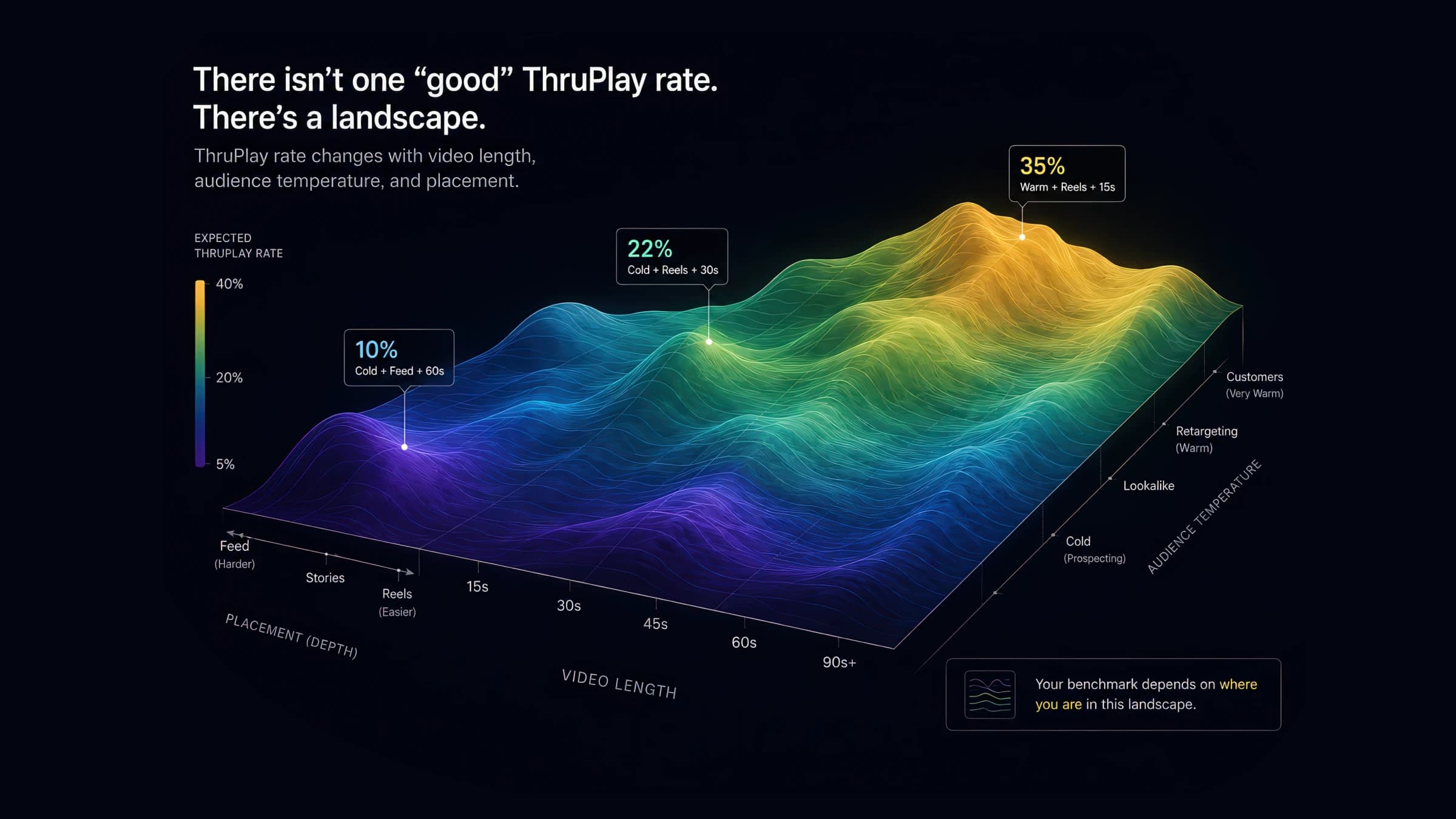
ThruPlay benchmarks shift 10–30 points by video length, placement, and audience temperature. See the full 2026 segmented data — and which number to actually cite.
AI-powered marketing tools

As Meta automates audience, placement, budget, and creative optimization, the hunt for a single winning ad is a weaker scientific unit. The better question is which creative features—hooks, proof, messengers, contexts—compound signal across delivery environments.
AI-powered marketing tools
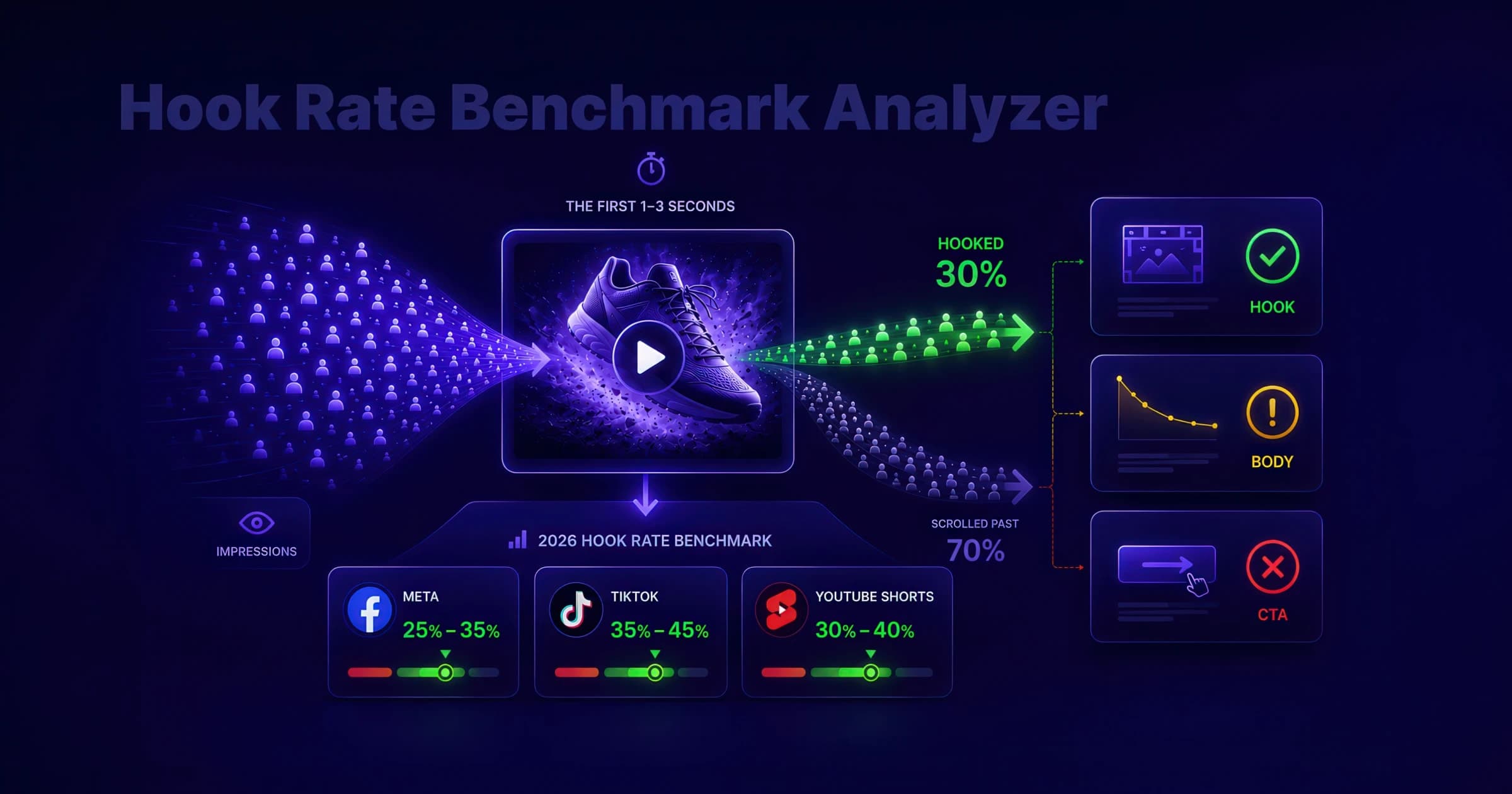
Calculate hook rate (thumbstop rate) for Meta, TikTok, and YouTube Shorts, compare it to 2026 benchmark ranges, and diagnose whether your video ad needs a stronger first frame, tighter body, or clearer CTA.

Analyze audience drop-off and retention to find exactly where viewers stop watching your videos. Works for YouTube, Vimeo, TikTok, and Facebook analytics data.
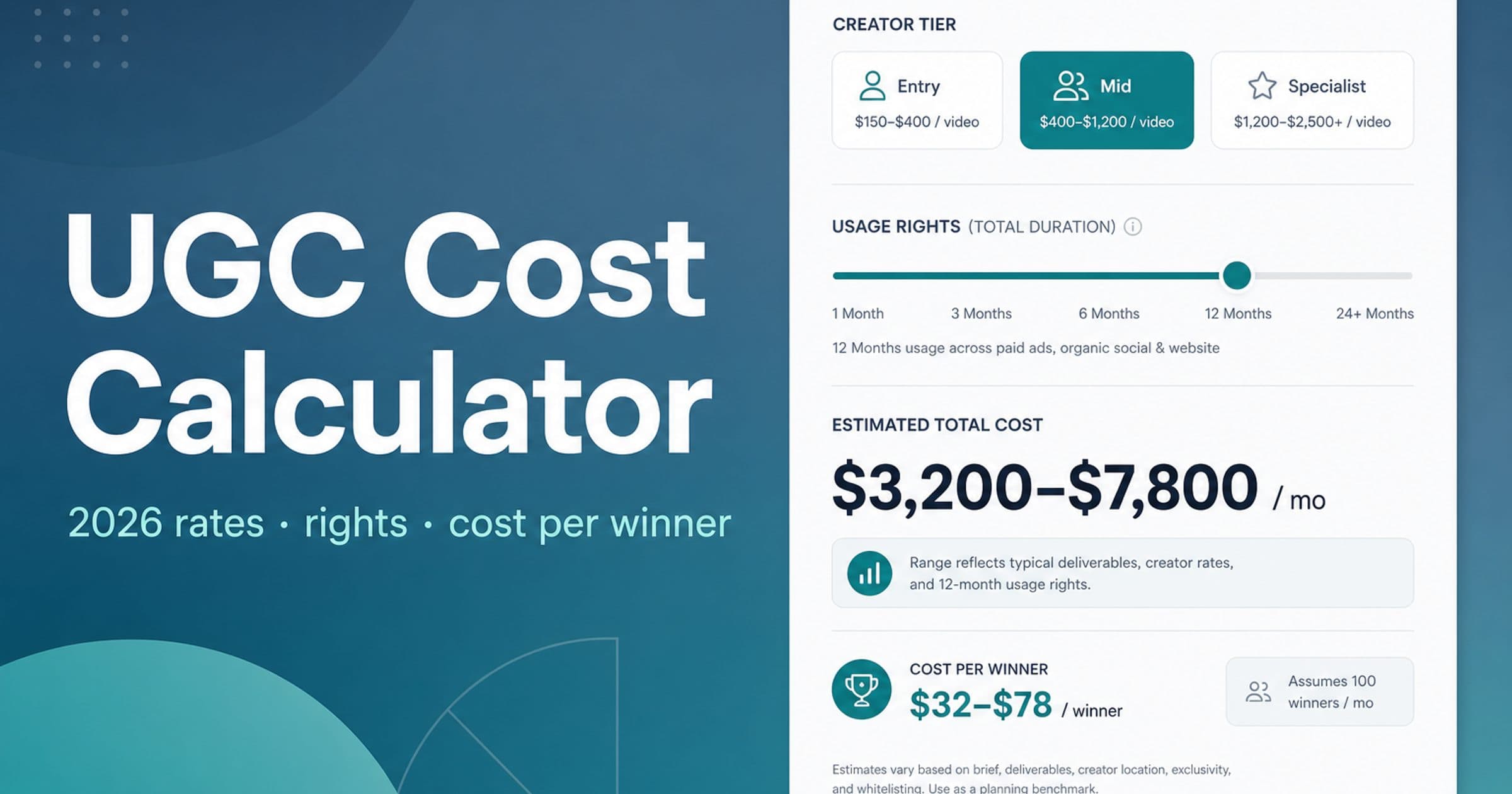
Free UGC cost calculator with independently researched 2026 creator rates, paid usage-rights uplifts, whitelisting, niche premiums, DIY vs agency vs hybrid AI paths, and cost-per-winner framing. Export your scenario to CSV.
Thumbstop Rate measures the effectiveness of creative in capturing attention by tracking the percentage of users who stop scrolling to engage with the content in their feed for a meaningful duration, typically 2-6 seconds depending on the platform.
User-Generated Content in advertising refers to authentic content created voluntarily by actual customers and brand advocates without direct compensation or formal brand partnership. This includes organic reviews, social media posts, testimonials, and other content that brands may repurpose for marketing with permission. UGC is distinguished from Creator-Generated Content (CGC) by its purely organic nature and lack of commercial arrangement.
Variance is the average of the squared differences between each data point and the mean — the foundational measure of how spread out a metric's values are. In digital advertising, variance quantifies the volatility of metrics like daily CPA, ROAS, or CTR: a campaign averaging a $50 CPA with low variance delivers predictable results, while the same average with high variance swings between cheap and expensive days. Because the differences are squared, variance is expressed in squared units, so practitioners usually report its square root — the standard deviation — while variance itself powers significance tests and sample-size math.
A Call to Action is a directive in advertising designed to prompt the viewer to take a specific action, such as 'Learn More,' 'Buy Now,' or 'Subscribe.' Effective CTAs are clear, direct, and visually prominent.
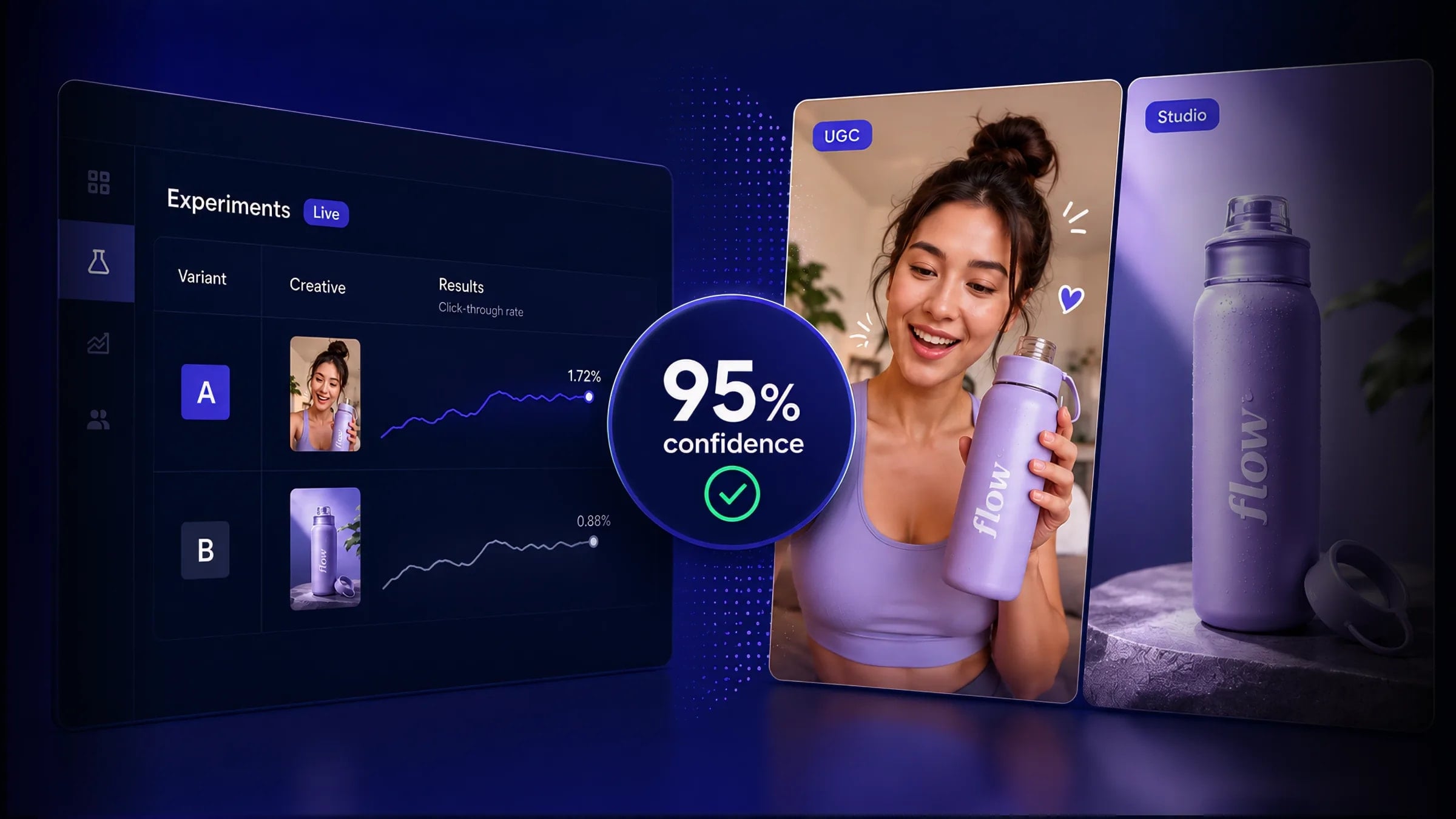
Most Meta creative tests declare false winners. This playbook covers hypothesis design, Meta Experiments setup, sample-size math, and the three-metric read that separates signal from noise.
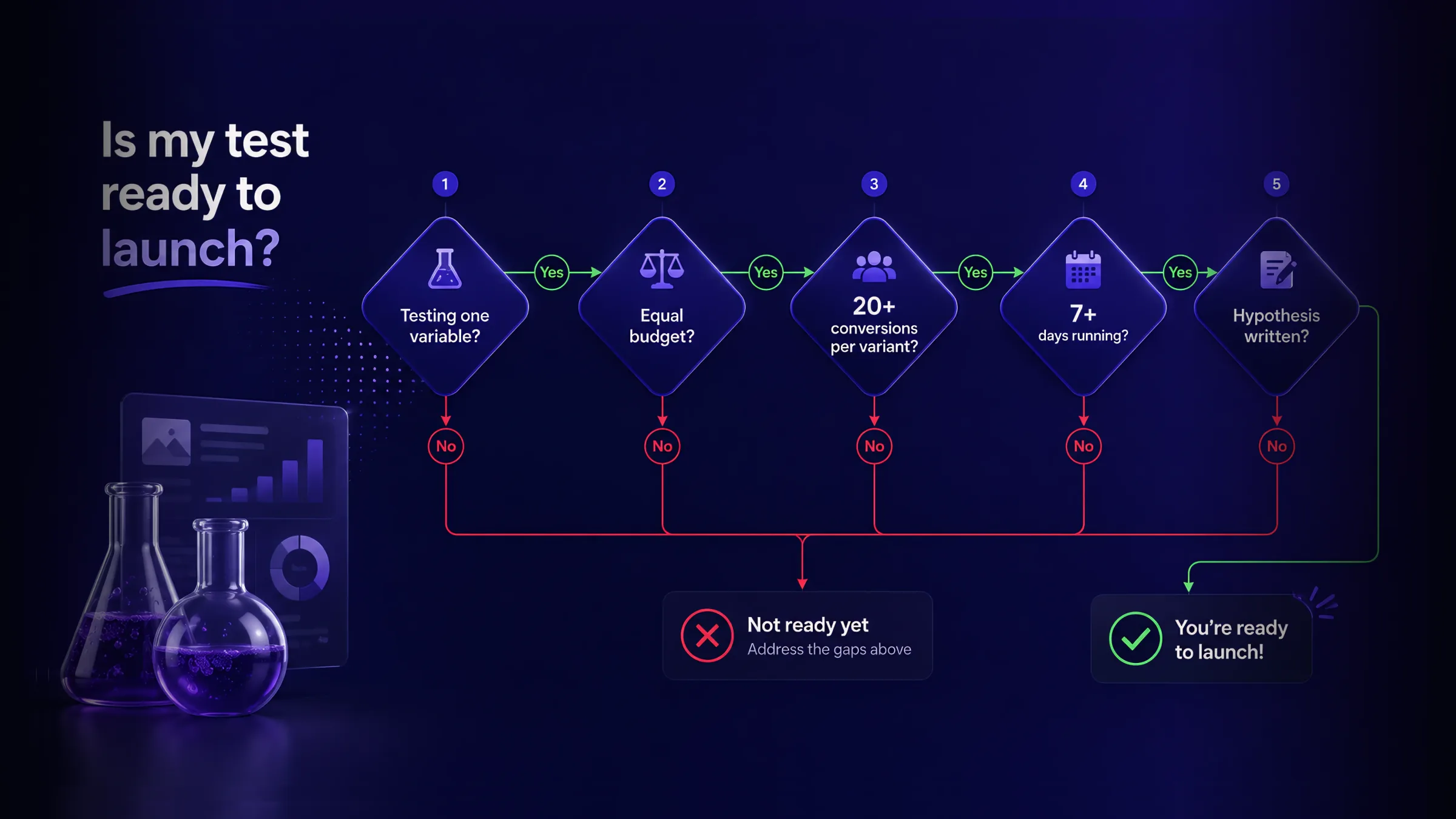
Short answer: a Meta creative test only proves something when you write the hypothesis first, isolate one variable, use Meta's Experiments tool (not manual on/off), run at least 7 days with enough budget for 20–50 conversions per variant, and require 95% confidence before you scale. The rest of this post is the full workflow — from hypothesis template through the three-metric read that catches false winners our statistical noise post warns about.
Most teams running Meta creative tests are not running experiments. They are running asset roulette: launch five hooks in one ad set, check results after 48 hours, kill the "loser," and call it learning. Meta's own documentation is explicit that informal testing — turning ad sets on and off manually — produces unreliable results because audiences overlap and delivery is inefficient. The Experiments tool exists precisely because clean comparison requires randomized, non-overlapping audience splits.
This is the first published article in our Creative Testing topic hub. It complements the Creative Testing Framework guide with a Meta-specific execution playbook — not another lecture on p-values (see our statistical noise article for that), but the operational sequence that turns a test from theater into evidence.
Creative is the highest-leverage variable in Meta performance — platform documentation and practitioner consensus both rank creative above audience and placement for impact. That leverage cuts both ways: a well-designed test compounds into a creative library; a poorly designed test compounds into false confidence.
The four failure modes we see most often:
If any of those sound familiar, the fix is structural — not more variants, but a tighter test design. The covers the general methodology; what follows is the Meta-specific execution layer.
A test without a written hypothesis is a mood board with a budget. Use this template before you open Ads Manager:
Strong example: "If we change the opening hook from product-first (0–3s product shot) to problem-first (0–3s pain-point question), then thumbstop rate will improve by 15%+ because cold audiences on Reels respond to tension before product recognition."
Weak example: "Let's test some new creatives and see what happens."
The strong version isolates one variable, names a measurable outcome, and states why — which tells you what to tag in your creative library if the test wins. For tagging discipline, see Creative Feature Models: Beyond the Winning Ad.
Meta offers three practical paths. They are not interchangeable — each trades cost, speed, and statistical integrity.
For most teams serious about building a creative library, Experiments is the default. Manual splits are a fallback, not a preference.
One variable. Equal budget per variant. Same audience, landing page, and optimization event. Pre-defined end date.
Creative testing has a natural priority order. Test the highest-leverage variable first — you get more signal per dollar.
Underfunded tests are the silent killer of creative programs. A test running $15/day per variant needs 14+ days to accumulate enough optimization events; a test at $50/day reaches significance in 7–10 days for most conversion objectives.
Use this planning grid before launch:
Plug your numbers into the and before you publish. If the calculator says you need 35 conversions per variant and your budget only buys 12, shrink the test (fewer variants, longer run, or higher daily budget) — do not run it anyway and squint at the results.
A creative test winner must align across three metric layers — not just the primary metric Meta declares.
A variant that wins on thumbstop but loses on CPA is not a winner — it is a hook worth iterating, not scaling. Document the layer where each test resolved in your .
A test that does not update your creative library is a test you will repeat. After every concluded test, log:
Teams that compound this way raise the floor on every subsequent test. Teams that do not — the ones still asking "what should we test next?" in every Monday standup — are paying tuition on the same lesson repeatedly.
If you are starting from zero, here is the smallest test that still produces defensible evidence:
Creative testing is not a side project for performance marketers — it is the operating system. Run it formally, and every dollar teaches something. Run it informally, and every dollar buys a story you will tell in the Monday meeting until the budget runs out.
Changing hook, format, and offer simultaneously. When the winner lands, you cannot know which change drove it — so the 'learning' does not transfer to the next brief.
Checking daily and killing the trailing variant on day three. The learning phase and incomplete attribution windows make early leaders unreliable; many reverse by day seven.
Duplicate ad sets with 'similar' targeting instead of using Experiments. Overlapping audiences violate the independence assumption — you are comparing correlated samples, not isolated variants.
Declaring victory on CTR alone while CPA worsens. Upper-funnel lifts that do not convert are creative entertainment, not creative proof.
Illustrative — peeking and early stops inflate the nominal 5%
Days Meta practitioners recommend at minimum
Before scaling budget to a winner
Hypothesis template: "If we change [single variable] from [A] to [B], then [primary metric] will improve by [expected direction/magnitude] because [audience/psychology rationale]."
Best for: Concept-level tests where results will inform strategy — UGC vs studio, static vs video, angle A vs angle B.
Randomized, non-overlapping audiences. Meta calculates significance automatically. Supports up to five variants[4].
Trade-off: Higher setup friction; needs adequate budget per cell.
Best for: Quick tests while building a new campaign — duplicate an ad and change one variable from the toolbar.
Same randomization guarantees as Experiments when published as a formal test.
Trade-off: Easy to accidentally run as informal duplicate rather than formal test.
Best for: Very small budgets where Experiments minimums are prohibitive.
Equal budgets per ad set, identical targeting, same conversion event. You calculate significance externally.
Trade-off: Audience overlap risk; algorithmic delivery variance between ad sets. Use only with larger sample sizes and external significance checks via our .
We do not recommend testing informally, such as by turning ad sets or campaigns on and off manually. This can lead to inefficient ad delivery and unreliable test results.
Lock everything except the test variable
Same targeting, exclusions, and advantage+ settings
Same URL, offer, and checkout flow
Same conversion event and attribution window
Same placement mix unless placement IS the variable
Change exactly one creative dimension
Valid single-variable tests: hook (first 3 seconds), visual format (UGC vs studio), messenger (founder vs customer), primary text length, CTA framing, or offer presentation. Invalid: new hook + new music + new end card — that is three tests wearing one trench coat.
Same daily budget per variant
Meta recommends equal budgets for fair comparison[6]. Use ABO (ad set budget optimization) during tests, not CBO — CBO will starve the slower-learning variant before it reaches significance.
Set start and end before launch
Schedule the test duration in Experiments or Ads Manager A/B setup. Minimum 7 days; 10–14 days for conversion-optimized campaigns. Do not peek and stop early — that inflates false-positive rates.
The first 3 seconds determine whether anyone sees the rest. Test problem-first vs product-first, question vs statement, face-to-camera vs b-roll. Measure with before CPA — a hook test that lifts attention but not conversion still teaches you something about the opening.
UGC vs polished studio, static vs 15s video vs 30s video, carousel vs single image. Format tests are expensive (production cost) but high-impact — they change the entire attention contract with the audience.
Founder vs customer testimonial vs expert authority. The messenger changes trust transfer; it is often the second-most impactful variable after hook.
Price visible vs hidden, percentage discount vs dollar value, free trial vs money-back guarantee. Test offer framing only after hook and format are stable — offer tests confound easily with audience temperature.
Purchases, leads, trials
Conversions per variant
20–50
Days minimum
7–14
Meta's learning phase targets ~50 optimization events per ad set per week.
Thumbstop, ThruPlay, CTR
Impressions per variant
5,000–10,000
Days minimum
7
Faster to reach volume, but still require full week for day-of-week variance.
Thumbstop rate, ThruPlay rate, 3-second video views.
Did the variant win because more people stopped — or despite fewer stops?
CTR, outbound clicks, landing page views.
Did attention convert to click intent?
CPA, , conversion rate.
Did intent convert to revenue? This is the layer that matters for scaling.
Expand each scenario
Meta flags statistical significance at 95% confidence. If attention, intent, and conversion metrics align with the declared winner, scale with confidence. Apply the learning to your creative library tags.
Meta may declare a winner on cost-per-result while CTR and thumbstop tell opposite stories. Segment by placement (Reels vs Feed) and device before accepting — placement mix shifts can manufacture winners.
Below 20 conversions per variant or stopped before day 7: treat as directional only. Run a confirmatory test before scaling budget.
The compounding loop that separates testing programs from asset roulette
Log the outcome
Encode the feature
Feed the next test
Kill confirmed losers
One variable, expected metric direction, rationale. Open the A/B Test Tracker template.
Run Creative Testing Calculator. Confirm 20+ expected conversions per variant over 7 days.
Two variants, equal budget, same audience and optimization event. Schedule 10-day end date.
No budget shifts, no early stops. Monitor delivery health only (rejected ads, learning limited).
Check confidence level, attention/intent/conversion alignment, placement breakdown.
Update creative library. Write next hypothesis. Schedule confirmatory test if confidence was below 95%.
This workflow pairs with creative fatigue detection — tests tell you what to make next; fatigue monitoring tells you when to retire what is running. For video-specific hook diagnostics, see the video ad hook optimization guide.

