Stay Updated
Get the latest insights on creative testing and ad optimization delivered to your inbox.
Get the latest insights on creative testing and ad optimization delivered to your inbox.

Continue reading about this topic with these recommended articles.
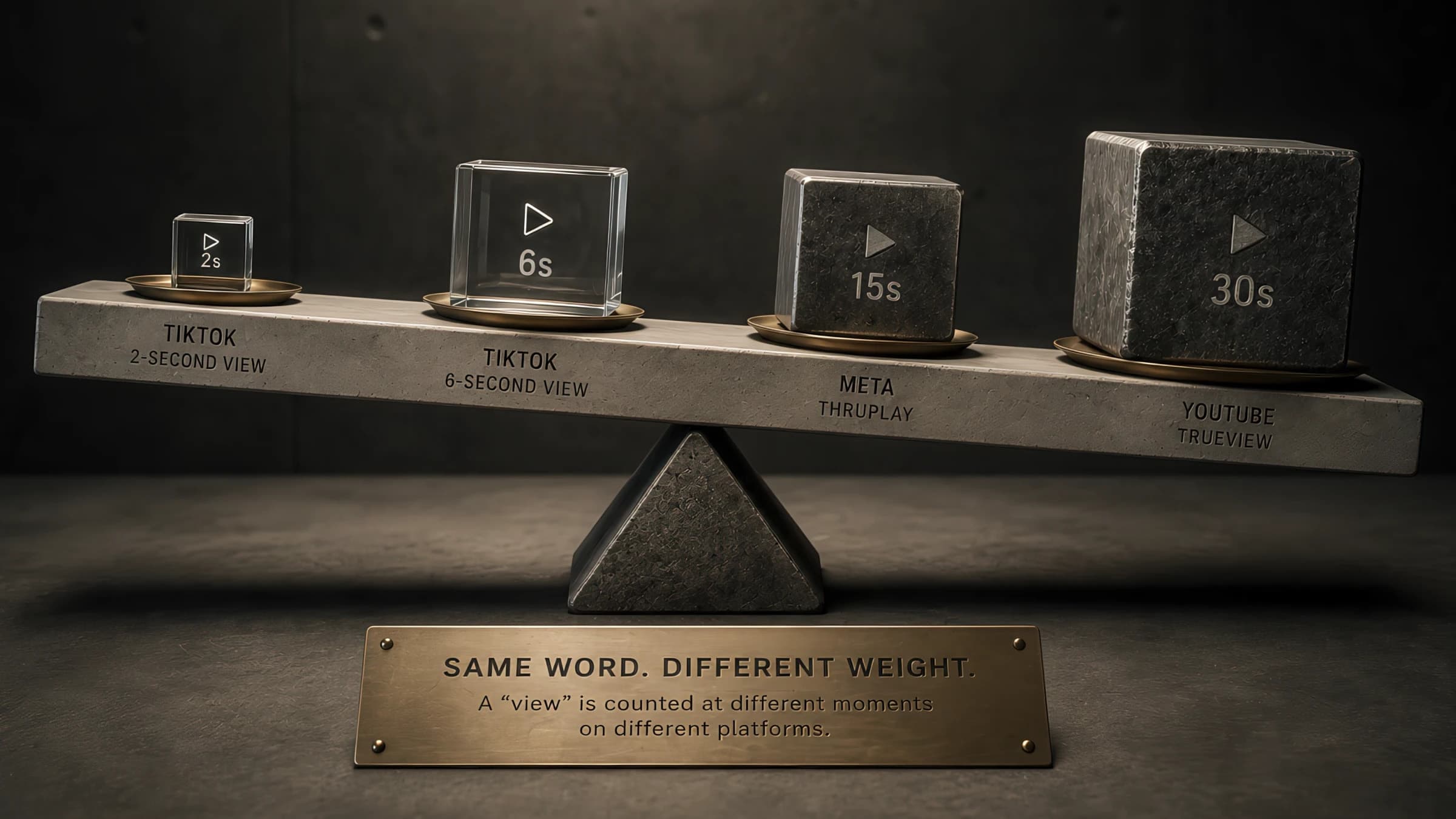
ThruPlay is a Meta-specific term, but the underlying mechanic — counting a view at a specific threshold — exists differently on TikTok, YouTube, and CTV. Here's how the metrics actually compare and where cross-platform benchmarks break down.

AI-powered marketing tools
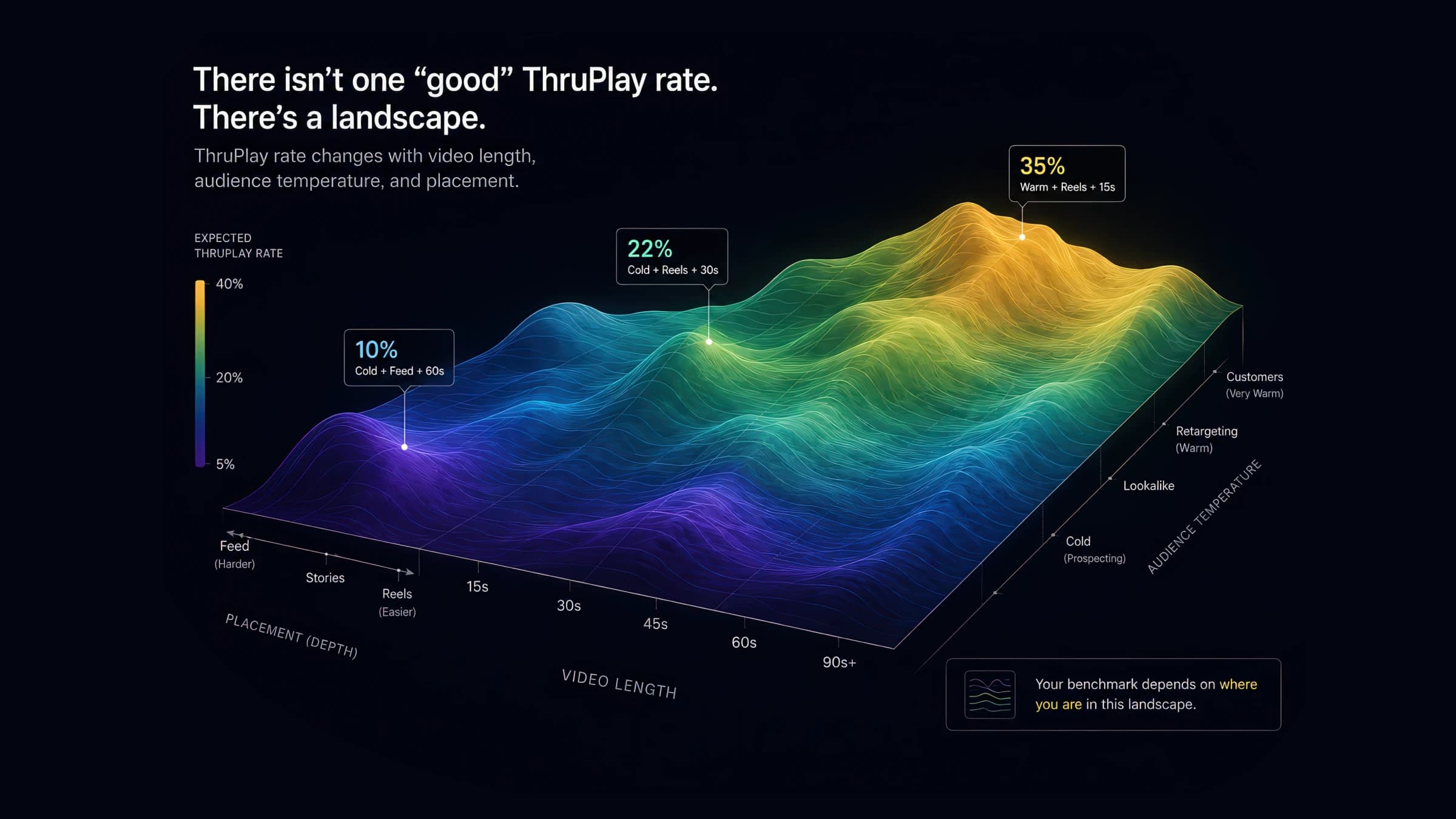
ThruPlay benchmarks shift 10–30 points by video length, placement, and audience temperature. See the full 2026 segmented data — and which number to actually cite.
AI-powered marketing tools
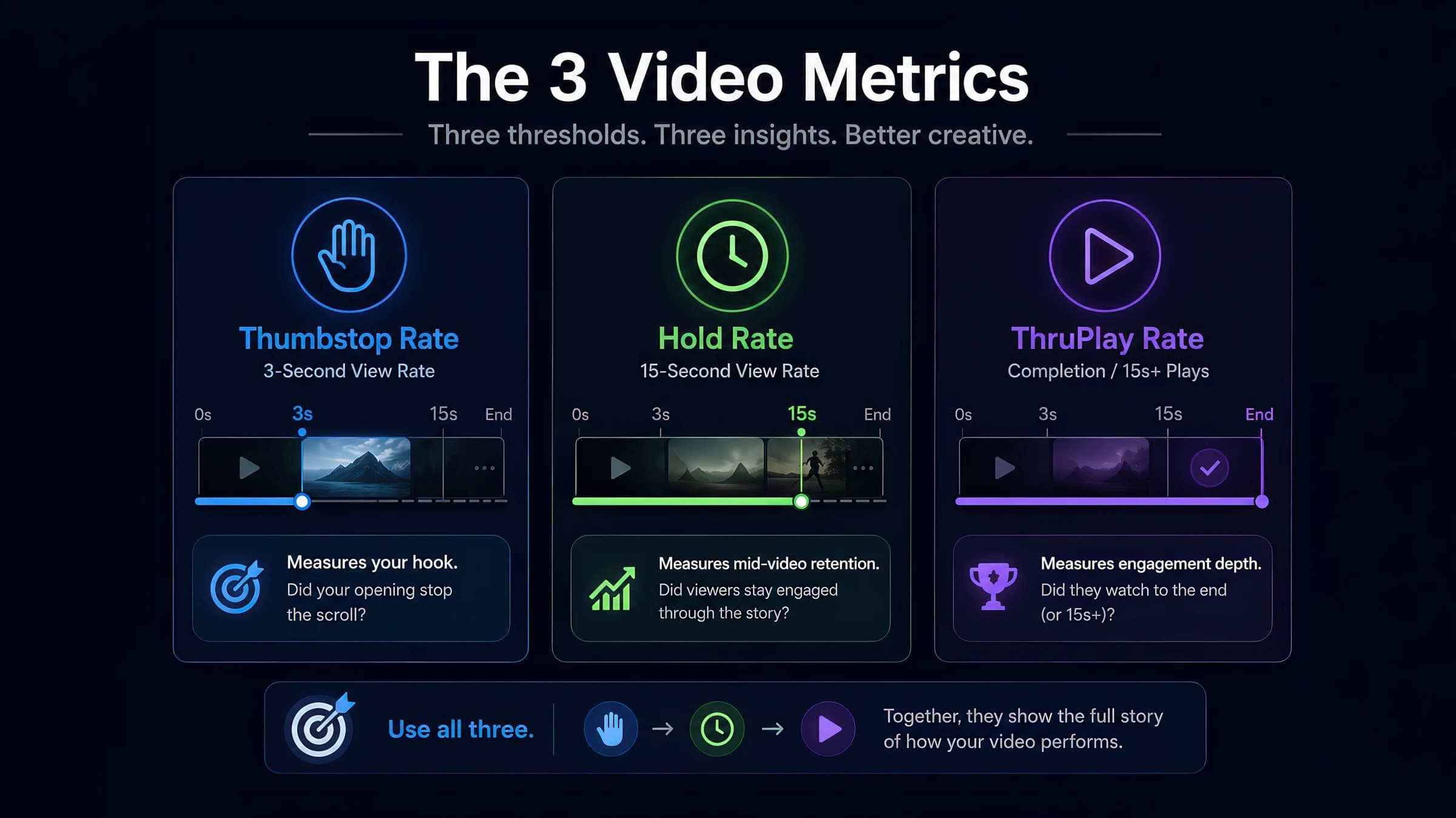
Meta Ads Manager hides the creative diagnostics that matter behind custom columns. This walkthrough shows exactly where to find thumbstop, hold, and ThruPlay — and how to read them without false conclusions.
AI-powered marketing tools

Learn how to calculate video completion rate step by step, then run your own numbers: our free VCR calculator shows what percentage of viewers watch to the end, with full retention and drop-off context. Works from YouTube, Vimeo, TikTok, and Facebook analytics data — benchmarked against platform averages.

Analyze audience drop-off and retention to find exactly where viewers stop watching your videos. Works for YouTube, Vimeo, TikTok, and Facebook analytics data.
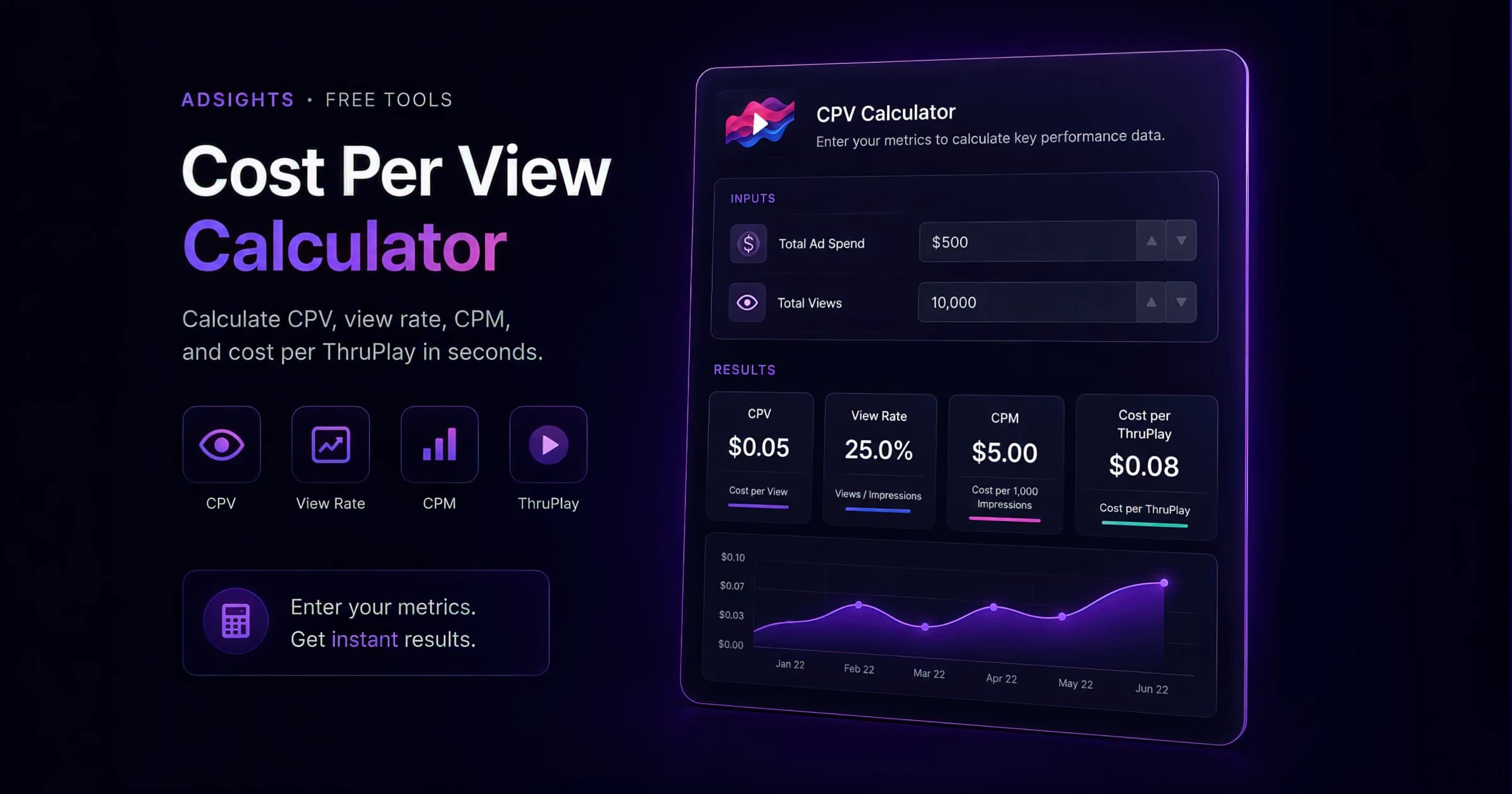
Free CPV calculator for video campaigns. Enter spend and counted views to get cost per view. Add impressions for view rate and CPM, or ThruPlays for cost per ThruPlay — with worked examples, platform view definitions, and 2026 benchmarks for YouTube, Meta, and TikTok.
Video Completion Rate measures the percentage of video ad impressions that are watched to 100% completion. This metric helps evaluate creative engagement, message delivery effectiveness, and audience targeting accuracy while accounting for video length and placement quality. VCR is particularly important for brand messaging where full creative viewing is crucial.
ThruPlay Rate measures the percentage of video plays where users watch either the entire video (for videos under 15 seconds) or at least 15 seconds (for longer videos). This is the denominator Meta reports against; on Meta, autoplay keeps video plays ≈ impressions. The metric evaluates content's ability to maintain viewer attention and deliver complete messages, particularly important for platforms like Meta and TikTok.
View Through Rate (VTR) most commonly measures the share of ad impressions that become platform-counted views: VTR = (counted views ÷ impressions) × 100, with YouTube TrueView counting a view at 30 seconds or completion. In attribution contexts, VTR instead means the share of impressions that led to a conversion without a click. Always confirm which meaning a report uses.
ThruPlay is Meta's standard video-view event, counted when a viewer watches a video to 15 seconds — or to completion if the video is shorter. It is both a reported metric and a biddable optimization/billing event, and it replaced Meta's retired 10-second video view. ThruPlays ÷ video plays gives the ThruPlay Rate; spend ÷ ThruPlays gives Cost Per ThruPlay. The term is Meta-specific.
Step-by-step formulas for the three core video-engagement metrics — Video Completion Rate, ThruPlay Rate, and View-Through Rate — with worked examples and the platform-specific quirks that trip up cross-platform comparisons.
Video Completion Rate (VCR), ThruPlay Rate, and View-Through Rate (VTR) overlap at the edges and get reported differently per platform, which leads operators to wrong-budget decisions when they treat the three numbers as interchangeable. This guide walks each formula, the worked example, the platform-specific quirks, and a comparison block at the end to make the choice of which metric to use in which decision unambiguous.
If you're trying to decide which metric to anchor on, the comparison table at the bottom is the fastest answer. If you need the math with examples, read top to bottom. For consolidated 2026 benchmark ranges and a diagnostic workflow, see the Video Creative Metrics Benchmarks 2026 guide.
VCR measures the share of video views (or impressions, depending on platform) that reach 100% completion of the video. The formula is VCR = (Video Views Reaching 100% Completion / Total Video Views) × 100, where the denominator is the number of viewers who reached the platform-specific "view" threshold — Meta starts counting at the play event, YouTube counts at impression on TrueView, TikTok counts at 2 seconds, and CTV counts at impression because the inventory is non-skippable.
Worked example. A 30-second video ad on Meta gets 100,000 video plays, of which 18,000 reach the 100% completion event (the viewer watched the entire 30 seconds). That works out to VCR = (18,000 / 100,000) × 100 = 18%. Cross-platform completion data places 30s+ creative at a median completion around 52% — but that's a cross-platform aggregate including non-skippable inventory. On skippable Meta in-feed, 18% on a 30s creative is normal cold prospecting, above 25% is strong, and the cross-platform completion picture from sub-30s is materially higher (HubSpot and Sprout Social both report 60%+ completion on the sub-30s formats — TikTok 72%, Shorts 54%, Reels 61%).
VCR reports differently on each platform. Meta surfaces it as "Video Plays at 100%" under longer creatives and unifies it with ThruPlay on shorter creatives where completion equals the threshold. YouTube reports completion as four quartiles (25%, 50%, 75%, 100%) in Google Ads — most teams call the 100% quartile VCR. TikTok exposes "Video Completion Rate" directly in Ads Manager, but because TikTok counts a view at 2 seconds the denominator is dramatically more permissive than YouTube's — TikTok VCR isn't directly comparable to YouTube VCR. CTV reports VCR as the primary attention metric because the inventory is non-skippable; rates of 95%+ are normal because viewers can't drop out before completion. For deeper coverage see Video Completion Rate glossary entry.
ThruPlay rate is Meta-specific. The formula is ThruPlay Rate = (ThruPlays / Video Plays) × 100, where a ThruPlay is either a complete view of a video under 15 seconds, OR at least 15 seconds of view time on a video 15 seconds or longer. The term doesn't apply on YouTube, TikTok, or CTV — each has its own threshold definition.
Worked example. A 45-second video ad on Meta gets 80,000 video plays, of which 9,600 cross the 15-second threshold. The remaining 70,400 viewers either skipped before the threshold or never started. That works out to ThruPlay Rate = (9,600 / 80,000) × 100 = 12%. The cited 15–30s cold-prospecting band is 18%–28% on Reels/Stories, so a 12% rate on a 45-second creative is in the same neighbourhood as 22% on a 22-second creative — the longer the format, the more punishing the threshold mechanic. The same 12% on a 22-second video would be below the public benchmark for that length bucket. Once you've worked out your own rate, drop it into the ThruPlay Rate Benchmark to see which length-and-placement band it lands in.
The thing operators most often miss is that ThruPlay rate and VCR are not the same metric. A 60-second video can have a 25% ThruPlay rate (1 in 4 viewers crossed the 15-second mark) and a 3% VCR (only 3 in 100 watched the full 60 seconds). ThruPlay measures whether viewers cleared the 15-second threshold; VCR measures whether they finished. Optimise for ThruPlay if attention is the goal (awareness, video views); pair with VCR to confirm the closing message and CTA are actually getting seen. For more depth on benchmarks see ThruPlay Rate Benchmarks 2026 by Video Length, Placement & Audience.
VTR is the most-confused video metric because the term has two distinct meanings depending on context. Always confirm which definition your reporting tool uses before benchmarking.
VTR = (Counted Views / Impressions) × 100. On YouTube TrueView in-stream, a counted view requires 30 seconds of watch time (or completion of a shorter video, or a click). VTR in this sense measures the share of impressions that survived the 5-second skip button and reached the 30-second threshold.
Worked example. A YouTube TrueView campaign delivers 500,000 impressions, of which 160,000 viewers watch at least 30 seconds. That works out to VTR = (160,000 / 500,000) × 100 = 32%. 32% is roughly the industry median for TrueView in-stream — above 35% is strong, above 40% is top quartile. Short-form creatives (under 30s) hit the threshold mechanically so they show higher VTR; long-form creatives (60s+) drop materially lower because most viewers skip before clearing 30 seconds. YouTube Shorts (vertical, swipe-native) runs higher than in-stream TrueView at 35%–55% per the same Store Growers report.
VTR = (View-Through Conversions / Total Ad Impressions) × 100. This is the post-view attribution metric — the share of ad impressions that resulted in a conversion within the platform's view-through attribution window (commonly 1 day or 7 days), without the viewer clicking the ad.
Worked example. An awareness campaign delivers 2,000,000 impressions, and the platform attributes 2,000 conversions to view-through events within the 1-day VT window. That works out to VTR = (2,000 / 2,000,000) × 100 = 0.10%. View-through conversion rates of 0.05%–0.20% are typical for awareness video on Meta; expect view-through to drop materially in 2026 as Meta's Attribution Settings move toward shorter VT windows.
The key distinction. YouTube TrueView VTR (Meaning 1) is an attention metric — what share of impressions converted to engaged views. The view-through conversion rate (Meaning 2) is an attribution metric — what share of impressions led to downstream conversions without a click. Same acronym, completely different metrics, completely different uses. Confirm the source before benchmarking.
The three metrics measure related but distinct aspects of video attention. The table below clarifies what each measures and when to use which.
The cross-platform compatibility row is the most important read for operators building cross-channel video reports. Only VCR is consistently defined across Meta, TikTok, YouTube, and CTV (always 100% completion), so it's the most stable cross-platform comparison metric. ThruPlay is Meta-only. TrueView VTR is YouTube-only. The view-through conversion rate exists on multiple platforms but the attribution window differs by platform, so cross-platform comparison without window normalisation is misleading.
The most common mistake is conflating the two VTR definitions. A reporting tool that surfaces "VTR" without specifying threshold leaves the consumer guessing whether 32% means "YouTube TrueView view rate" (good — above industry median) or "view-through conversion rate" (catastrophic — implies the conversion rate is 32%, which is impossible for non-branded video). Always check the column header definition before benchmarking.
The second is mixing length buckets when comparing ThruPlay rate or VCR. A campaign that averages 28% ThruPlay rate across 15-second and 60-second creatives is mostly telling you the length mix, not creative quality. Segment by length first.
The third is treating VCR on CTV as comparable to VCR on Meta or YouTube. CTV inventory is non-skippable, so VCR rates of 90%+ are normal and tell you nothing about creative quality — every viewer is mechanically completed unless they walk away from the TV. Use TVR (target viewable rate) or attentive-viewer metrics from third-party measurement instead.
The fourth is optimising sales objectives for cheap ThruPlay. ThruPlay is an attention metric, not a conversion metric. Optimising a purchase campaign for cheap ThruPlay typically acquires viewers, not buyers — blended ROAS drops 15–25% within two weeks. Use ThruPlay rate as a creative-quality diagnostic and conversion optimisation for sales objectives.

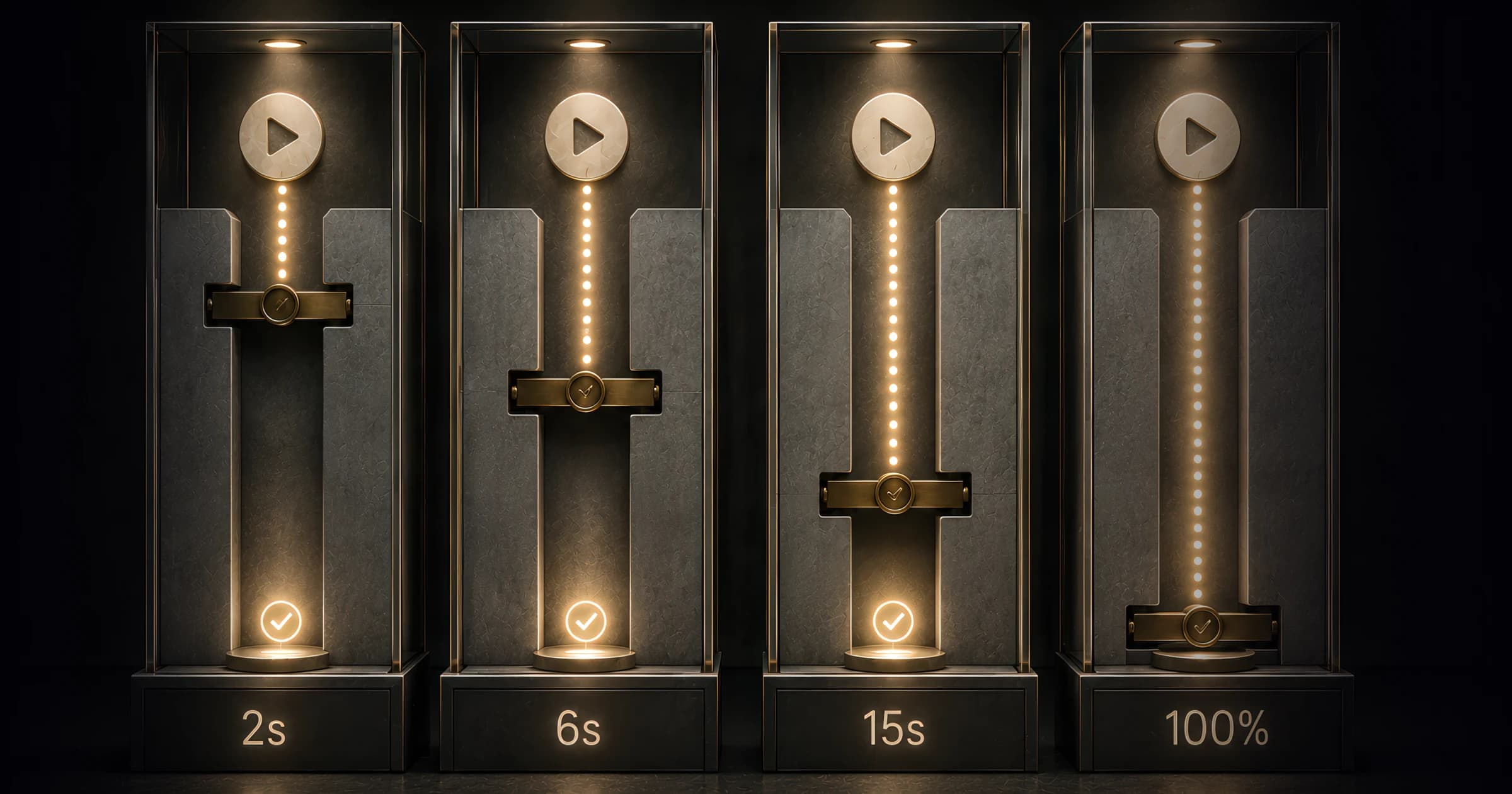
Metric | Threshold | Where reported | Best for |
|---|---|---|---|
| VCR (Video Completion Rate) | 100% of video length | All platforms (consistent definition) | Cross-platform attention comparison; verifying closing-message exposure |
| ThruPlay Rate | 15s OR full completion (whichever is shorter) | Meta only | Mid-funnel attention benchmark for Meta creative quality |
| VTR (TrueView View Rate) | 30s OR full completion OR click | YouTube TrueView in-stream | YouTube creative quality + bid efficiency |
| VTR (View-Through Conversions) | 1d or 7d post-view conversion window | Meta, DSPs, ad-server measurement | Awareness-campaign attribution; view-driven incrementality |
| View Rate | Platform's minimum view (3s Meta / 2s TikTok / 30s YouTube) | All platforms (threshold differs) | Hook strength; share of impressions that became views at all |

