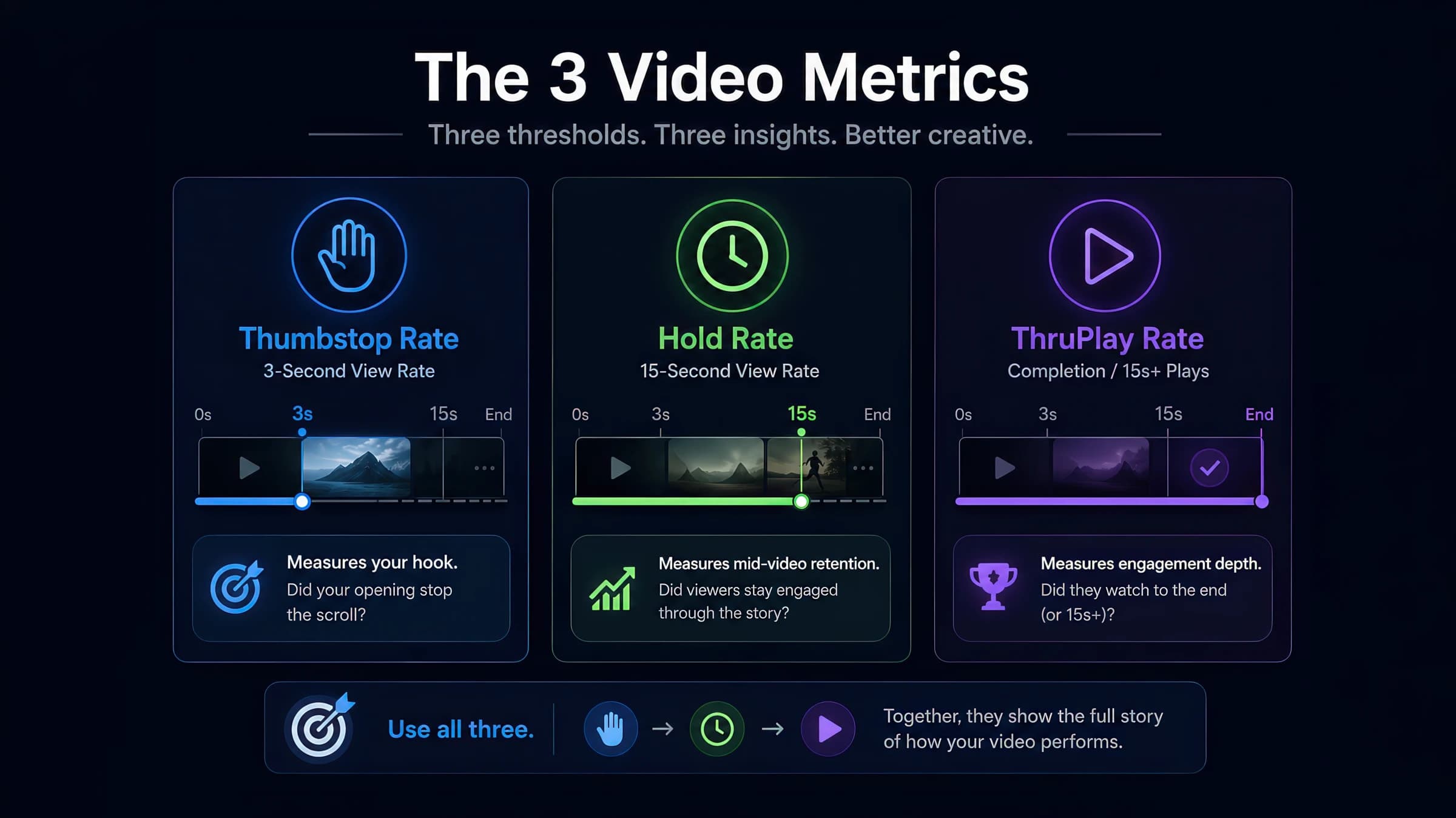
Video Creative Metrics Benchmarks 2026: Thumbstop, Hold & ThruPlay
Cited 2026 Meta ranges for thumbstop rate, hold rate, and ThruPlay — segmented tables, methodology, and free analyzers to score your creative.
Quick takeaway
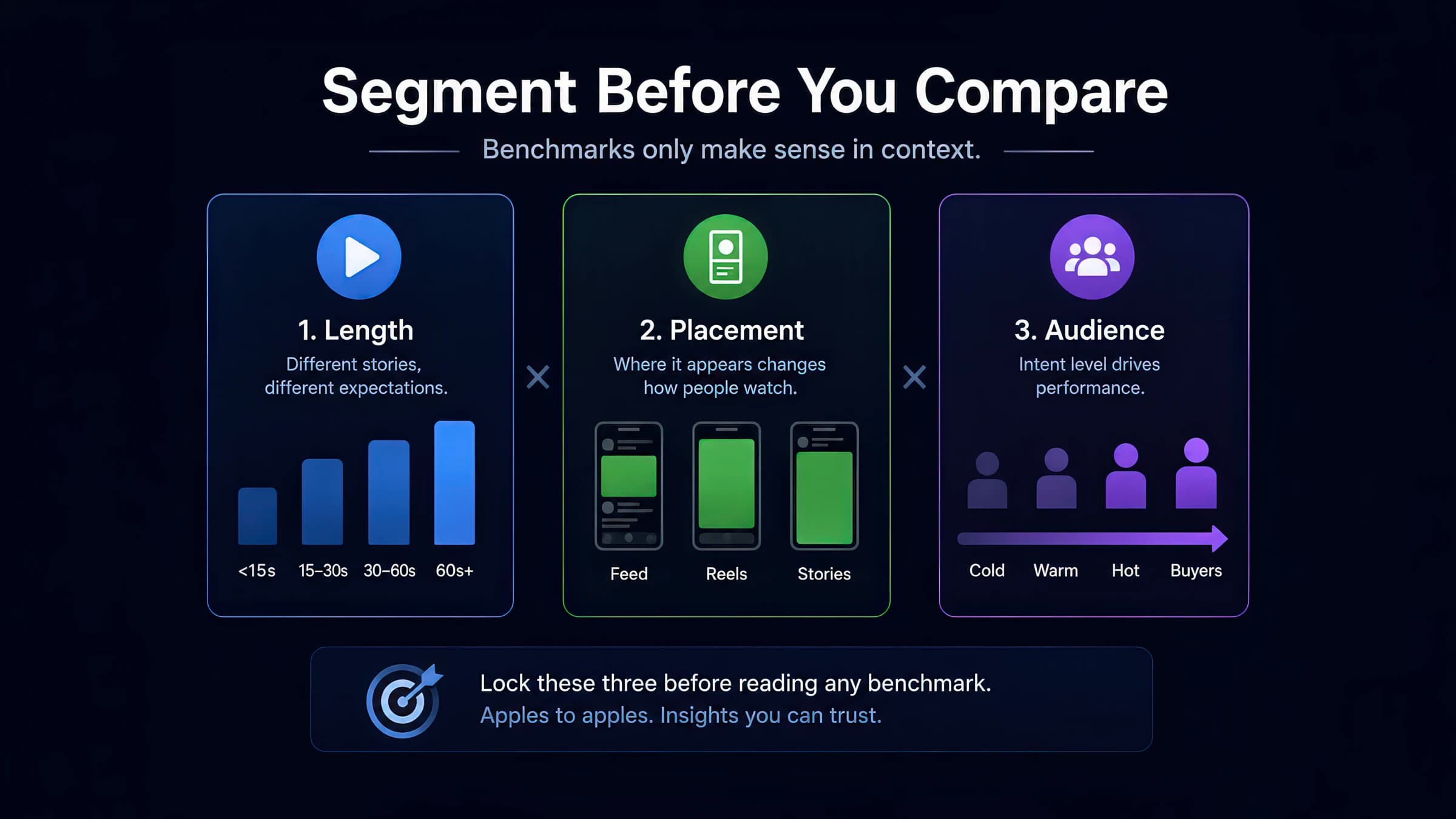
Compare video creative on three thresholds — 3s hook, 15s hold, and ThruPlay — only after segmenting by length, placement, and audience temperature. Every cell below cites a public source.
Methodology: How These Benchmarks Are Built
Ranges are directional — not account-specific predictions — and always require segmentation.
This page consolidates cited public ranges from platform documentation, practitioner reports, and an independent web research pass (June 2026) across adlibrary.com, Vaizle, Billo, Sepia Lab, Zeely, eonik.ai, MHI Growth Engine, Affect Group, Dynamoi, Triple Whale, and Nielsen-derived completion compilations. We do not publish a single “industry average” without context.
Research process
- Start from Meta’s official metric definitions (3-second views; the 15-second-or-completion ThruPlay threshold)
- Pull third-party tier tables that name their formula and year (Sepia Lab’s 2026 hook-rate roundup is the best cross-vendor comparison we found)
- Cross-check practitioner reports that publish ranges with segmentation (length, placement, or audience temperature)
- Flag when two sources use the same metric name but different formulas (hold rate is the worst offender — see the definitions section below)
- Drop any cell where no 2024–2026 source publishes the full segmentation — we note dropped cells explicitly rather than inventing numbers
Inclusion rules
- Every table row must name a source and the segment it applies to
- Meta ThruPlay ranges use Video Plays as the denominator (what Meta reports) unless a row notes otherwise — on Meta, autoplay keeps Video Plays ≈ impressions, so the bands hold either way; confirm your dashboard’s denominator before comparing
- Thumbstop / hook rate = 3-second video views ÷ impressions on Meta (Meta has no official hook-rate benchmark — Sepia Lab, 2026)
- Hold rate on this page defaults to 15-second video views ÷ 3-second video views unless a row explicitly notes a different formula
How to use this page
- Pick your platform, length bucket, and audience temperature
- Confirm your formula matches the cited source’s formula
- Enter your metrics in the linked analyzers below
- Compare range-relative verdicts — not raw leaderboard rankings
- Document learnings in your creative testing framework
Metric Definitions (Meta)
Three thresholds, three denominators — mixing them is the most common benchmarking mistake.
| Metric | Formula | Threshold | Source |
|---|---|---|---|
| Thumbstop / hook rate | 3-second video views ÷ impressions | 3 seconds | Meta Ads Manager columns; practitioner convention (Billo, Vaizle 2026) |
| Hold rate (15s retention) | 15-second video views ÷ 3-second video views | 15 seconds among hooked viewers | adlibrary.com Hold Rate guide; Sepia Lab 2026 (Motion 15s dataset cited therein) |
| Hold rate (ThruPlay funnel) | ThruPlays ÷ 3-second video views | 15 seconds or completion (sub-15s) | Vaizle 2026; Sepia Lab hook roundup 2026 |
| Hold rate (watch depth) | Average video play time ÷ video length | Continuous (% of ad watched) | MHI Growth Engine DTC guide |
| ThruPlay rate | ThruPlays ÷ video plays | 15 seconds or completion (sub-15s) | Meta Business Help Center — About ThruPlay |
| Video completion (VCR) | 100% video views ÷ video plays | Full watch | Nielsen completion data (via Amra & Elma compilation) |
Official ThruPlay definition: a ThruPlay counts when a viewer watches a video to completion (videos under 15 seconds) or for at least 15 seconds (longer videos); Meta treats ~97%+ as completion. It does not count ad clicks — a common misconception worth unlearning. Source: Meta Business Help Center — About ThruPlay.
Because ThruPlay also fires on sub-15-second completions that a raw 15-second-video-views count never captures, pair ThruPlay with hold rate when diagnosing watch depth. See Hold Rate vs ThruPlay Rate.
Hold Rate Has Four Common Definitions — Pick One
The same label hides incompatible formulas; mixing them is the #1 benchmarking mistake after skipping segmentation.
Independent research (June 2026) across adlibrary.com, Vaizle, Billo, Sepia Lab, and MHI Growth Engine found four formulas all called “hold rate.” They are not interchangeable — a dashboard showing 45% and one showing 18% can describe the identical ad.
| Definition | Formula | Typical cold range | Who uses it |
|---|---|---|---|
| 15-second retention | 15-second video views ÷ 3-second video views | 15–25% healthy; <10% kill floor | adlibrary.com (Foreplay + Triple Whale composite); Sepia Lab 2026 |
| 75% completion retention | Video plays at 75% ÷ 3-second video views | 8–15% healthy; <5% kill floor | Meta Ads Manager `video_p75_watched_actions`; adlibrary.com |
| ThruPlay funnel hold | ThruPlays ÷ 3-second video views | 40–50% average; 60%+ strong | Vaizle 2026; Motion via Sepia Lab 2026; Billo Meta reporting |
| Watch-depth percentage | Average video play time ÷ video length | 28–40% on 30s DTC ads | MHI Growth Engine 2026 |
Why the numbers look “wrong” side by side: Vaizle’s ~45% “hold” and adlibrary’s ~18% “hold” can describe the same ad because ThruPlay counts sub-15-second completions in addition to 15-second-plus plays, inflating the numerator versus raw 15-second video views. MHI’s 35% on a 30-second ad means ~10.5 seconds average watch time — a third metric entirely.
Default on this page: segmented hold tables below use 15-second views ÷ 3-second views unless a row says otherwise. When a vendor dashboard shows 40%+, check whether it is the ThruPlay funnel definition before comparing to our 15–25% cold band.
Thumbstop & Hook Rate Benchmarks (Meta)
The 3-second threshold — your earliest scroll-stop signal on Meta.
| Segment | Typical range | Median | Source | Note |
|---|---|---|---|---|
| Feed, DTC prospecting (cold) | 18% – 28% | ~23% | Sepia Lab 2026 (Motion in-feed dataset); Affect Group 2025; MHI Feed 2026 | Below ~18% usually signals opener failure on cold traffic |
| Reels, DTC prospecting (cold) | 24% – 36% | ~30% | Sepia Lab 2026; adlibrary.com Hook Rate 2026 (30–40% “good” band) | Placement conflict: MHI 2026 reports Reels 5–10pp below Feed — compare Reels-only to Reels-only |
| Stories, DTC | 22% – 32% | ~27% | Sepia Lab 2026; MHI Stories 2026 (12–22% avg, 22–32% strong) | Full-screen helps but skip behavior varies by creative format |
| Retargeting (warm) | 30% – 45% | ~36% | Sepia Lab 2026; adlibrary.com 2026 | Brand recognition inflates hook rate — not a standalone creative-quality signal |
| Cold traffic floor (kill signal) | n/a | n/a | adlibrary.com 2026; get-ryze.ai 2026 | Below 15% hook → pause or rebuild opener before scaling spend |
Practitioner hook tiers (Meta, 3s ÷ impressions). Meta publishes no official hook benchmark; these tiers come from creative-analytics vendors. The first four rows are the cross-vendor comparison in Sepia Lab’s 2026 hook-rate roundup; the Zeely row is from Zeely’s own Meta hook-rate analysis.
| Source | Needs work | Solid | Good / strong | Exceptional |
|---|---|---|---|---|
| Motion (2025) | below 25% | 25–35% | above 35% | baseline target 30–40% |
| Vaizle (2025) | below ~20% | ~20–25% | above 30% (top ads) | n/a |
| AdManage.ai (2025) | below 20% | 20–25% | 30–45% | 45%+ |
| Billo (2025) | below 25% | n/a | 35–45% | n/a |
| Zeely Meta analysis (2025) | below 15% | 20–25% | 30%+ strong | 30–50% after optimization |
TikTok hook benchmarks (2-second threshold — not Meta-comparable). TikTok hook rate uses 2-second video views ÷ impressions, so numbers run hotter than Meta 3-second rates for comparable attention. Source: Billo — Hook Rate to Hold Rate (Tuff Agency 11-account study cited therein).
| Tier | TikTok (2s) | Meta (3s) |
|---|---|---|
| Elite | 40%+ | 35–45% |
| Competitive | 30–39% | 30–39% |
| Fix-it zone | below 25% | below 25% |
| Account average (Tuff study) | 30.7% | ~24% (Billo Meta review) |
| Top quartile (Tuff study) | 40–45% | n/a |
Free Tool
Hook Rate Benchmark Analyzer
Calculate hook rate for Meta, TikTok, or YouTube Shorts and see where you land vs 2026 cited ranges.
Hold Rate Benchmarks (Meta)
15-second retention among viewers who already passed the hook.
| Segment | Typical range | Median | Source | Note |
|---|---|---|---|---|
| Feed, DTC prospecting (15–30s) | 15% – 25% | ~20% | adlibrary.com 2026 (Foreplay + Triple Whale composite); MHI 2026 (15s mark on cold 15–30s) | Below ~10% = mid-roll problem before scaling |
| Reels (any length) | 18% – 30% | ~23% | adlibrary.com 2026 (+5–10pp vs Feed at 15s hold) | Full-screen immersion holds hooked viewers longer |
| Longer video (30–60s), prospecting | 8% – 18% | ~12% | Triple Whale 2025; MHI 2026 (30s watch-depth 28–40%) | Harder on long creative; do not compare to sub-15s mechanical hold |
| Retargeting (warm) | 25% – 40% | ~30% | adlibrary.com 2026 (30%–50% higher than cold at 15s) | Warm audiences tolerate slower pacing |
| Sub-15s video (mechanical) | 50% – 80% | ~65% | Meta Business Help Center — ThruPlay | 15s threshold resolves on completion — weak standalone quality signal |
| Cold traffic floor (kill signal) | n/a | n/a | adlibrary.com 2026 | Below 10% at 15s÷3s → structural mid-roll problem before scaling |
Alternate hold definition — ThruPlays ÷ 3-second views (Vaizle / Billo / Motion via Sepia Lab). Same creative often reads ~2× higher here because ThruPlay also counts sub-15-second completions, not just raw 15-second views:
| Tier | Range | Source |
|---|---|---|
| Needs improvement | below 30% | Motion (2025, via Sepia Lab) |
| Average | 40–50% | Vaizle 2026; Motion (2025) |
| Strong | above 60% | Motion (2025) |
| Billo Meta target band | 25%+ minimum; 45% ideal paired with 35% hook | Billo 2026 |
Watch-depth hold (avg play time ÷ length) — MHI Growth Engine 2026 benchmarks by video length:
| Video length | Average hold | Strong hold |
|---|---|---|
| 15 seconds | 40–55% | 55%+ |
| 30 seconds | 28–40% | 40%+ |
| 60 seconds | 18–30% | 30%+ |
Hold rate isolates body performance: if thumbstop is strong but hold is weak, re-cut seconds 3–15 before touching the opener. Practitioner framing: Billo — Hook Rate to Hold Rate · Glued.me — Hook vs Hold guide.
ThruPlay Rate Benchmarks (Meta)
Meta’s 15-second engagement-depth metric — length and audience dominate the number.
| Segment | Typical range | Median | Source | Note |
|---|---|---|---|---|
| 15–30s, cold prospecting (Reels/Stories) | 18% – 28% | ~22% | Affect Group 2025; Dynamoi 2026 (25%+ good, 35%+ great) | Primary creative-quality band for standard performance video |
| 15–30s, cold prospecting (consensus band) | 15% – 25% | ~20% | Affect Group 2025; adlibrary.com 2026 | Below ~10% ThruPlay on cold 15–30s usually points to hook/early retention failure |
| 30–60s, cold prospecting | 8% – 18% | ~12% | Triple Whale 2025 | Longer videos lose roughly half of viewers before 15s on cold traffic — no public URL publishes finer 30–60s ThruPlay segmentation |
| Sub-15s (any vertical) | 70% – 95% | ~85% | Meta Business Help Center — ThruPlay; Nielsen via Amra & Elma (79.4% sub-15s completion) | Mechanically inflated — compare sub-15s creatives to each other, not to 30s+ ThruPlay |
| Retargeting (warm) | 25% – 45% | ~32% | Affect Group 2025 | +30%–50% over cold per adlibrary.com |
Free Tool
ThruPlay Rate Benchmark Analyzer
Enter your ThruPlay rate segmented by length and audience temperature for an instant range-relative verdict.
Full segmented analysis: 2026 ThruPlay benchmarks blog · ThruPlay interpretation guide · Hold rate glossary
Sources & Further Reading
Primary references used in the tables above.
Platform definitions
Independent research roundup (June 2026)
- Sepia Lab — Hook Rate Benchmarks 2026 — cross-vendor Meta hook tiers (Motion, Vaizle, AdManage.ai, Billo); placement table (Feed/Reels/Stories); notes no Meta-official hook benchmark
- adlibrary.com — Hook Rate (2026) — tier table (15–45%+); Reels 30–40% good band; kill floor below 15%
- adlibrary.com — Hold Rate (2026) — 15s÷3s cold band 15–25%; p75÷3s band 8–15%; kill floor <10% at 15s
- MHI Growth Engine — Hook Rate on Meta Ads (2026) — placement bands (Feed 20–30%, Reels 15–25%, Stories 12–22%); Reels vs Feed heuristic
- get-ryze.ai — Meta Video Ad Benchmarks 2026 — cold hook 25–35%; kill if <15%
- Vaizle — Hook Rate & Hold Rate (Jan 2026) — hook ~20–25%; hold = ThruPlays÷3s at ~40–50%
- Billo — Hook Rate to Hold Rate (Jun 2026) — Meta avg hook ~24%; Tuff 11-account TikTok avg 30.7%; ThruPlay÷3s hold reporting
- MHI Growth Engine — Hold Rate for DTC Video Ads (Feb 2026) — watch-depth hold (avg play time ÷ length) by video length
- Zeely — Boost Meta Hook Rate — practitioner tiers (<15% weak, 20–25% solid, 30%+ strong)
- Madgicx — Custom Metrics in Meta Ads — hook/hold custom column formulas; Number vs Percentage format pitfalls
- Benly.ai — Ad Creative Benchmarks 2026 — cross-platform hook medians (12k+ ad sample); no Meta vertical placement splits
Practitioner benchmark reports (2024–2026)
- Affect Group — Key Meta Ads Video Metrics Explained — 15–30s cold prospecting ThruPlay 18%–28%; cold band 15%–25%
- Dynamoi — Meta Ads Manager Metrics for Music Campaigns — vertical-specific ThruPlay tiers (25%+ good, 35%+ great)
- Triple Whale — Facebook Ads Benchmarks 2025 — aggregate ThruPlay/VTR ~29%; sub-15s vs longer splits
- Amra & Elma — Video ad completion rate statistics — Nielsen-derived completion data (79.4% sub-15s)
Hook → hold funnel framing
- Glued.me — Hook Rate vs Hold Rate
- FunnelInsiders — Thumbstop Ratio analysis — TSR alone weakly predicts ROAS (R²≈0.003 in cited cross-account study)
Internal cross-links
Retention Curves Beat Headline Hold %
Two ads with the same hold rate can need opposite fixes — chart drop-off second-by-second.
adlibrary.com’s 2026 hold guide argues the shape of the retention curve matters more than a single hold percentage. Pull quartile columns from Ads Manager (`video_p25`, `p50`, `p75`, `p100` watched actions) or use Motion / Triple Whale frame analytics when available.
| Curve shape | Where viewers leave | Likely fix |
|---|---|---|
| Cliff at 3–4s | Hook resolves; body never starts | Bridge hook tension one more second before product intro |
| Slow bleed 5–15s | Pacing — no pattern interrupts | Force a cut, text reveal, or audio shift every ~2s in the mid-roll |
| Cliff at 14–15s | Offer/CTA framing breaks trust | Reframe CTA as consequence (“without this, you keep paying X”) |
Mid-roll dead zone (seconds 8–15) is the most common cold-traffic failure mode in practitioner audits: high-retention creative changes visual information every 1.5–2.5 seconds through the middle; low-retention creative holds one shot 4–6 seconds. See Madgicx custom metrics guide for hook/hold column setup in Ads Manager.
The Three-Metric Diagnostic Stack
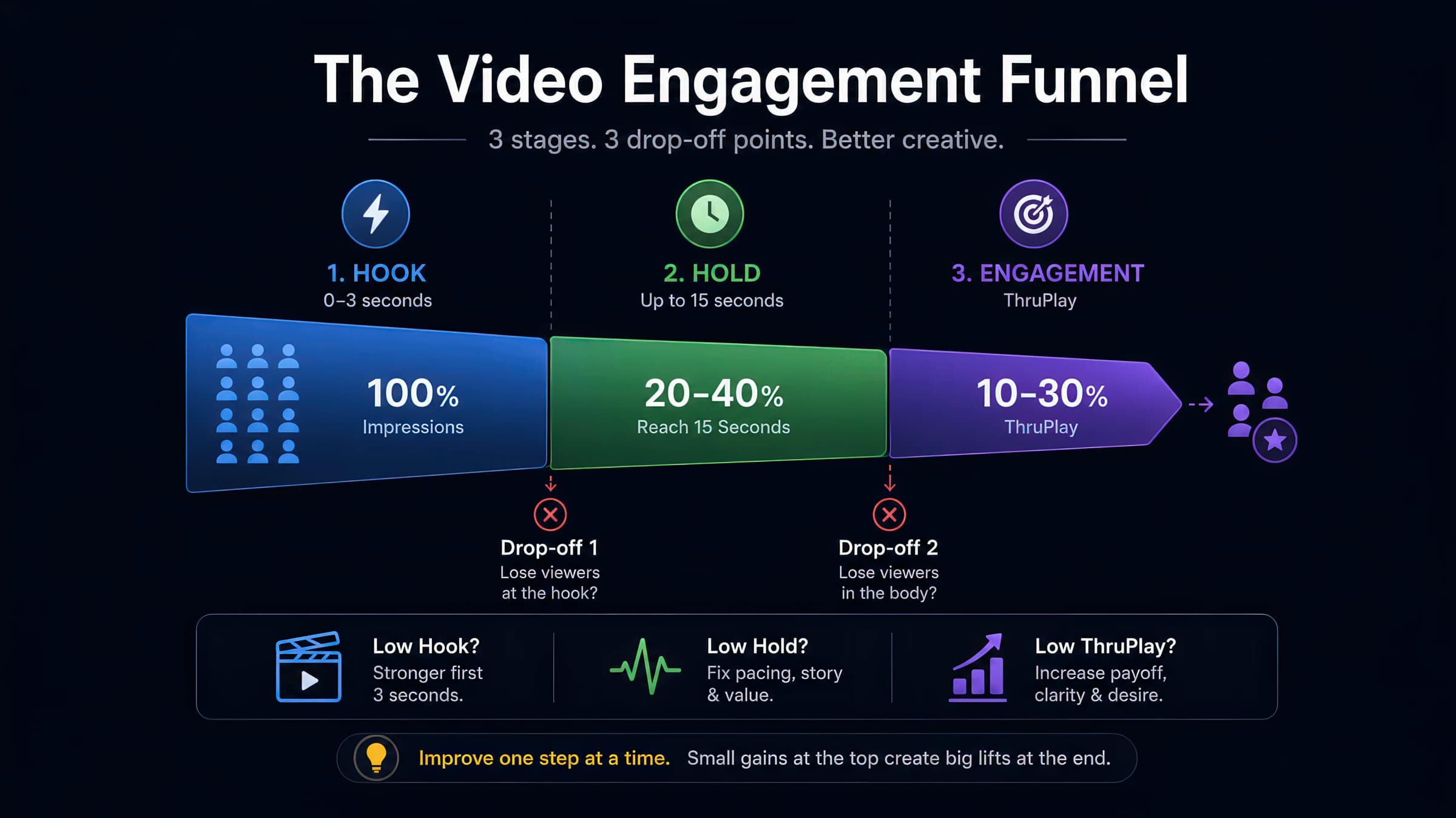
Read thumbstop → hold → ThruPlay in sequence to localize creative fixes.
- 1
Thumbstop weak, hold weak
Rewrite the first 1–3 seconds — motion, promise, and audience qualification. Do not edit the body until the hook clears ~20% on cold prospecting Feed.
- 2
Thumbstop strong, hold weak
Hook works; body loses viewers. Tighten pacing, front-load proof, cut dead air between 3–15 seconds.
- 3
Hold strong, ThruPlay weak vs peers
Unusual — check whether sub-15-second completions are inflating ThruPlay or whether placement mix skews the aggregate. Segment Reels vs Feed.
- 4
All three strong, ROAS weak
Engagement depth is not purchase intent. Shift optimization to conversion events or tighten offer/landing alignment.
Free Tool
Creative Quality Grader
Score hook, body, and CTA strength against benchmark rubrics in one pass.
Key Takeaways
- Never compare metrics across different length buckets
- Thumbstop diagnoses the hook; hold diagnoses the body
- ThruPlay counts sub-15s completions + 15s-plus plays (not clicks) — pair with hold rate for watch depth
- Drop benchmark cells when the source lacks segmentation — do not average mismatched cohorts
- Your account’s top-quartile history beats generic industry medians once you have volume
Frequently Asked Questions
Related Tools & Guides
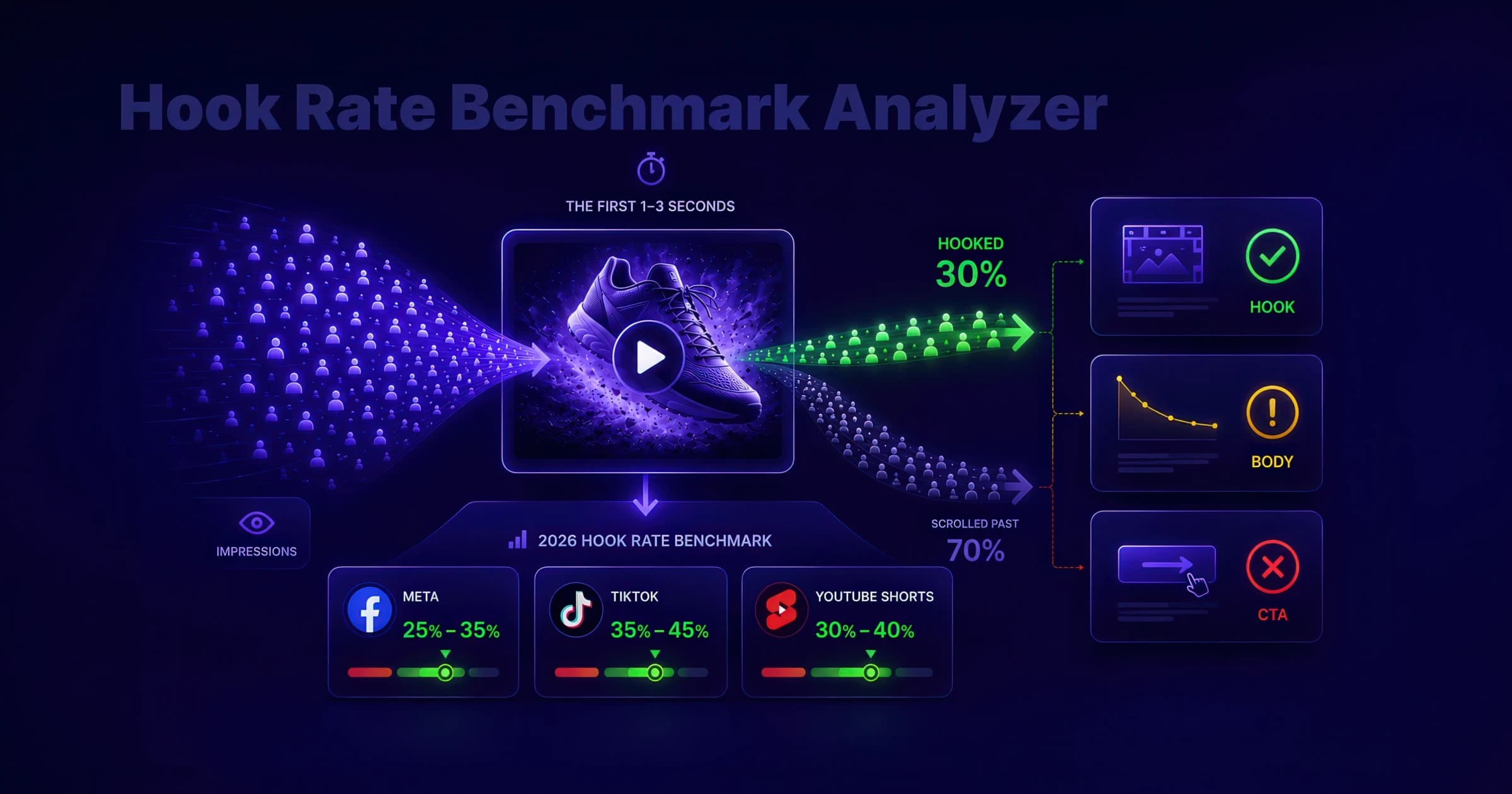
Hook Rate Benchmark
Calculate hook rate (thumbstop rate) for Meta, TikTok, and YouTube Shorts, compare it to 2026 benchmark ranges, and diagnose whether your video ad needs a stronger first frame, tighter body, or clearer CTA.
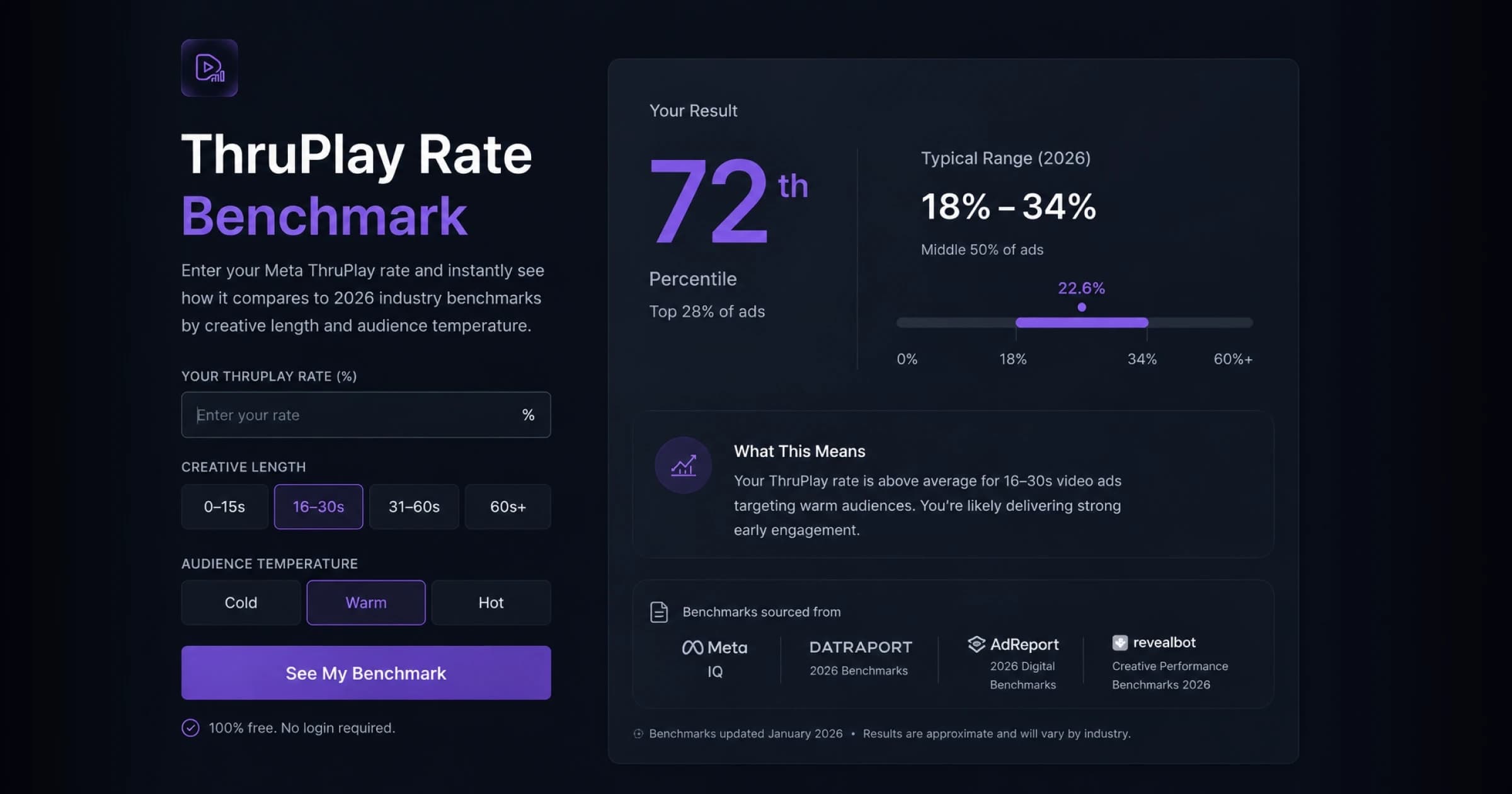
ThruPlay Rate Benchmark
Enter your Meta ThruPlay rate and instantly see how it compares to 2026 industry benchmarks by creative length and audience temperature. Free, no login — see where you land vs the cited typical range, with sources, and what your number means for creative performance.
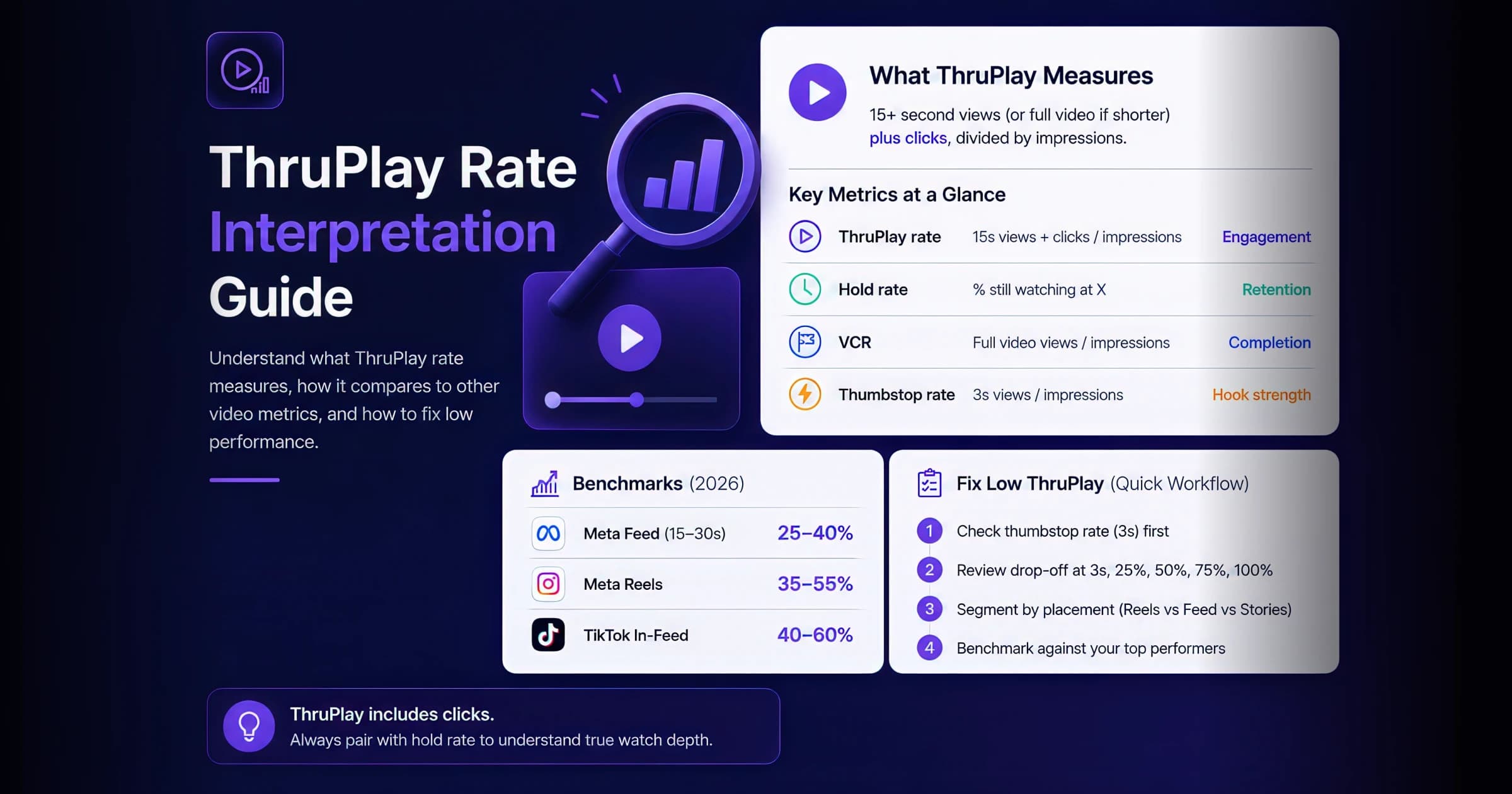
How to Interpret ThruPlay Rate (and When It Misleads You)
Understand what ThruPlay rate measures on Meta, how it differs from VCR and hold rate, when it misleads you, and a diagnostic workflow for underperforming video ads — with pointers to the canonical benchmark resources.
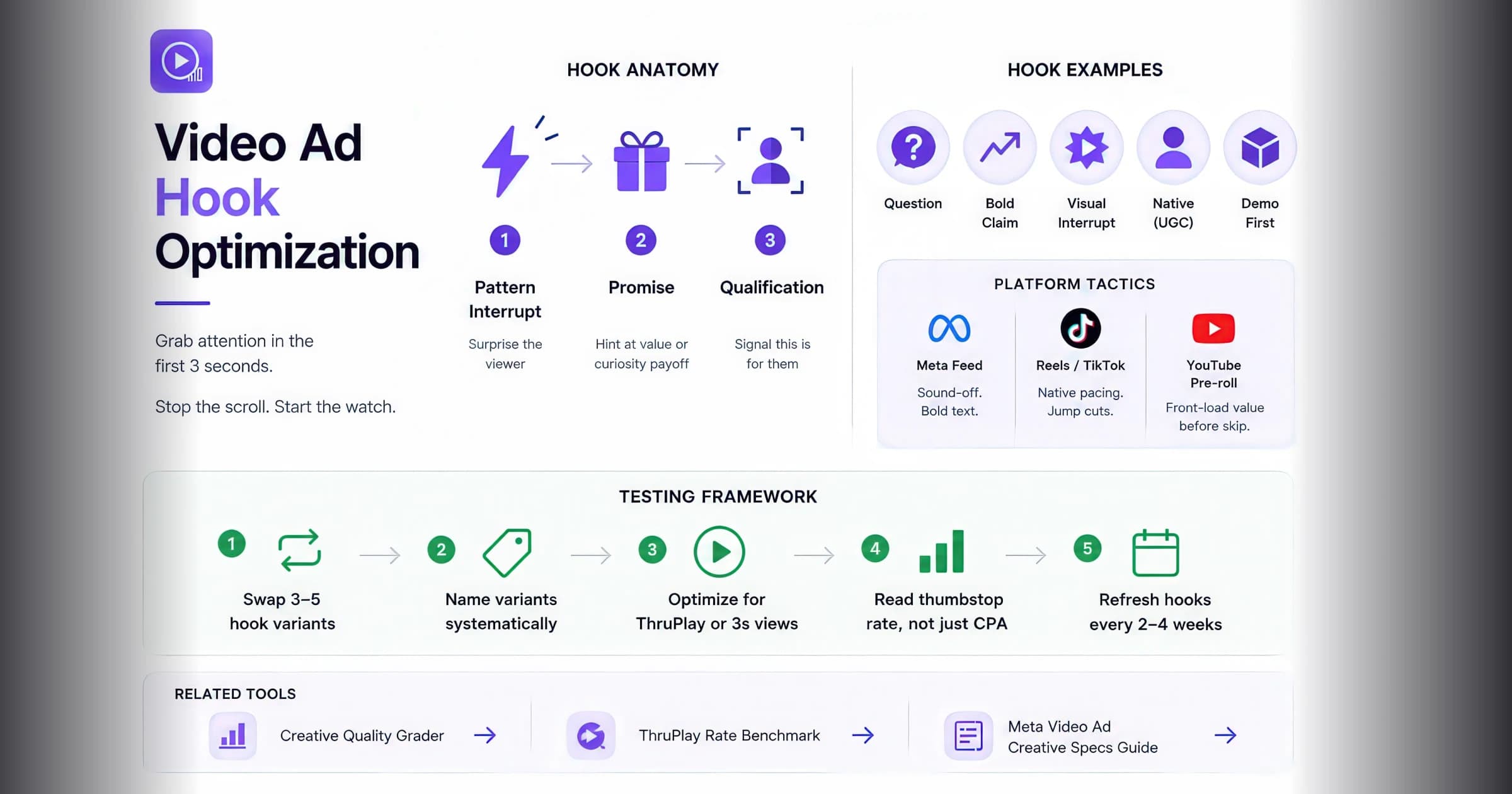
Video Ad Hook Optimization: Win the First 3 Seconds
Master the anatomy of high-performing video ad hooks — pattern interrupts, thumbstop tactics, platform-specific formats, and a repeatable testing framework for the first 3 seconds of your creative.

Creative Quality Grader
Grade your ad creatives and get actionable recommendations for improvement. This creative quality grader tool evaluates key elements like visual design, messaging, CTAs, accessibility, and platform optimization to help you create high-performing ads across Facebook, Instagram, TikTok, and YouTube. Get detailed scores and personalized tips to optimize your creative strategy.

Video Retention & Drop-Off Calculator
Analyze audience drop-off and retention to find exactly where viewers stop watching your videos. Works for YouTube, Vimeo, TikTok, and Facebook analytics data.
