Creative Testing Budget Calculator
Plan your creative testing budget effectively with our comprehensive calculator. Get expert recommendations for test duration, sample size, and budget allocation to ensure statistically significant results.
Topic Hub
Design, run, and interpret creative tests with statistical confidence. Explore A/B testing definitions, sample-size calculators, tracking templates, and methodology guides for Meta, TikTok, and YouTube creative.
13 curated resources across metrics, tools, templates, guides, and articles
Core glossary terms, formulas, and benchmark context for this topic.
The systematic process of evaluating ad creative variations to identify optimal performance through controlled experiments.
Controlled experimentation comparing two ad variants that differ by exactly one element to measure its impact.
Measure of whether results are likely due to chance or a real difference.
p-value < Significance Level
The number of observations in a sample, critical for the accuracy and reliability of statistical estimates.
n = (Z² * σ²) / E²
Range of values likely to contain the true population parameter.
CI = Point Estimate ± (Critical Value × Standard Error)
Systematically designed creative variants used for testing and audience targeting optimization.
Interactive calculators, analyzers, and generators to apply these concepts.
Downloadable templates that operationalize this topic in your workflow.
Educational guides and platform specifications.
Deep dives, benchmark reports, and strategic analysis from the AdSights blog.
Most Meta creative tests declare false winners. This playbook covers hypothesis design, Meta Experiments setup, sample-size math, and the three-metric read that separates signal from noise.
Most teams still edit video ads one export at a time. The AdSights Ads Framework packages compositions, a render CLI, and Claude Code skills so you can generate hook variants and platform sizes from a brief — here's how it works in plain language.
Creative testing is where opinion ends and evidence starts — but only when the test is designed to produce evidence. The most common failure mode is not "bad creative"; it is calling a winner after 200 conversions when the plan required 2,000, or comparing variants on different audiences and attributing the gap to the hook.
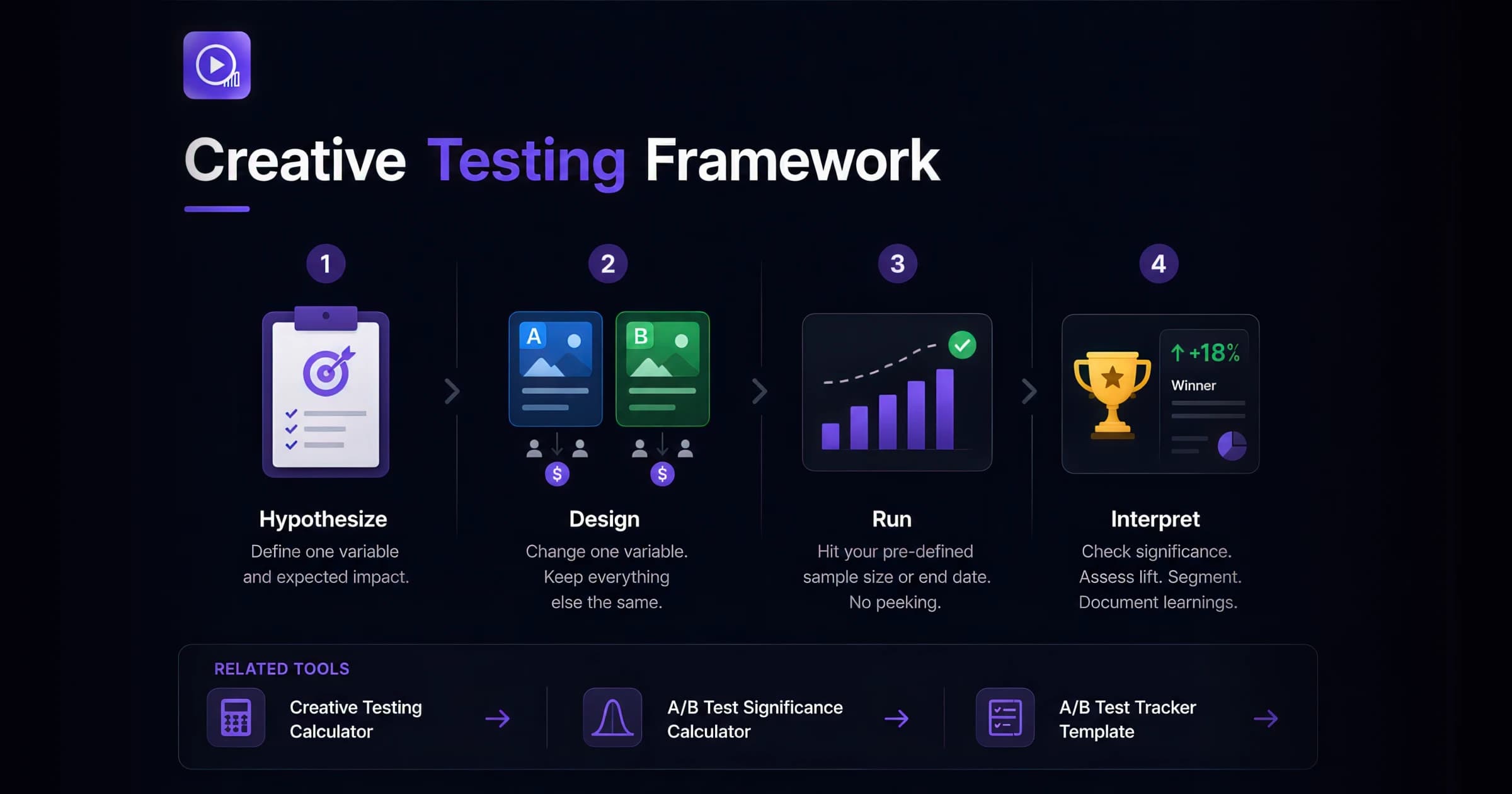
A rigorous creative test fixes three things up front: the metric that maps to the business decision (CTR and hold rate for learning; CPA or ROAS for scaling), the minimum detectable effect you care about, and the sample size each variant needs to detect it at 95% confidence. The calculators in this hub translate those inputs into budget and duration — use them before launch, not after you are already emotionally invested in a leader.
On Meta and TikTok, platform delivery adds noise: dynamic budget shift, learning phase, and audience expansion all change who sees which variant. Keep audiences and placements stable for the test window, limit the number of variants so each earns enough impressions, and resist peeking. When a variant wins with statistical separation, tag what made it win — hook style, format, offer framing — so the next iteration is a refinement, not a random relaunch.

Measure, benchmark, and interpret creative performance metrics.
Plan, diversify, and refresh creative before performance decays.
ROAS, MER, incrementality, and full-funnel efficiency metrics.
The statistics behind trustworthy tests — significance, sample size, power, and lift.