Cost Per Acquisition
The average cost to acquire a customer or generate a full conversion.
Definition
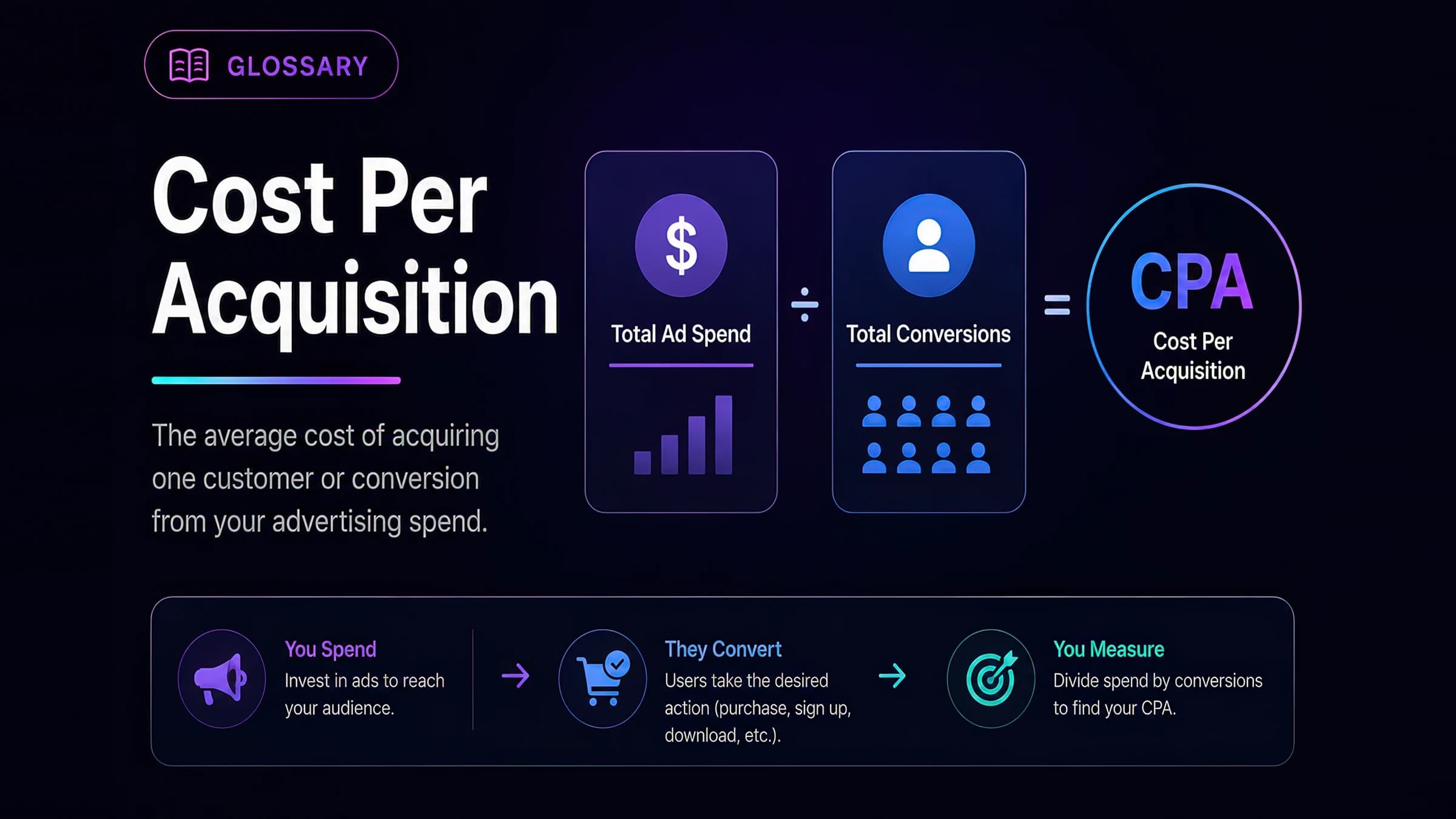
Cost Per Acquisition (CPA) measures the average cost required to acquire a customer or generate a complete conversion, such as a purchase, subscription signup, or other primary business objective. This metric focuses specifically on marketing and advertising costs associated with customer acquisition, making it distinct from the broader Customer Acquisition Cost (CAC) which includes all business costs.
Examples
E-commerce CPA of $45 for first-time customer purchases
SaaS platform CPA of $200 for new paid subscription signups
Mobile game CPA of $3.50 for users who complete tutorial
B2B service CPA of $750 for qualified sales opportunities
Calculation
How to Calculate
Divide total marketing and advertising spend by the number of successful customer acquisitions or primary conversions.
Formula
CPA = Total Marketing Cost / Number of AcquisitionsUnit of Measurement
$
Operation Type
divide
Formula Variables
Industry Benchmarks for Cost Per Acquisition
Typical performance ranges by industry segment. Benchmarks vary by platform, audience maturity, and attribution window — treat these as starting points, not targets.
DTC E-commerce (Meta)
- Typical range
- $30 – $50
- Median
- $37
Broad-interest targeting plus mature creative testing keeps purchase CPA in a narrow band across most retail categories.
Lead Generation (Search)
- Typical range
- $40 – $145
- Median
- $67
Wide spread because 'lead' definitions vary; legal and finance push the high end due to expensive keywords and intent competition.
B2B SaaS (paid trial / demo)
- Typical range
- $150 – $400
- Median
- $250
Demo and trial conversions are high-intent but rare; auctions are expensive and qualified-lead rate stays low.
Higher Education (enrollment lead)
- Typical range
- $75 – $130
- Median
- $95
Long enrollment cycle and limited intake windows pressure CPL upward, especially in regulated programs.
Subscription Apps (install-to-sub)
- Typical range
- $25 – $90
- Median
- $45
iOS ATT degraded signal post-iOS 14.5; install-to-paying-sub CPA varies heavily by trial length and price point.
Financial Services (account opening)
- Typical range
- $90 – $200
- Median
- $135
Regulated verticals, manual KYC drop-off, and aggressive incumbent bidding all inflate per-customer cost.
Sources: WordStream Facebook Ads Benchmarks 2024, WordStream / LocaliQ 2024, FirstPageSage 2024 SaaS Benchmarks, LocaliQ Search Advertising Benchmarks 2024, AppsFlyer / Adjust 2024 (cited in WordStream), WordStream 2024 / LocaliQ
Comparison
Related Metrics
Return on Ad Spend (ROAS)
Return on Ad Spend (ROAS) is a marketing performance metric that measures the revenue generated per dollar of advertising spend. Unlike ROI which considers all business costs, ROAS specifically evaluates advertising efficiency by comparing directly attributable revenue to ad spend. This metric is crucial for optimizing campaign performance, budget allocation, and overall marketing strategy.
Cost Per Action (CPA)
Cost Per Action (CPA) measures the average cost required to generate a specific user action or micro-conversion, such as form submissions, email signups, content downloads, or other engagement events. Unlike Cost Per Acquisition which focuses on customer acquisition, CPA tracks the cost efficiency of driving specific engagement milestones that may occur earlier in the customer journey.
Customer Lifetime Value (CLV)
Customer Lifetime Value predicts the total revenue a business can expect from a single customer account throughout the entire business relationship. This metric is crucial for determining sustainable customer acquisition costs, optimizing marketing spend, and identifying high-value customer segments. CLV helps businesses make informed decisions about customer acquisition and retention investments.
Customer Acquisition Cost (CAC)
Customer Acquisition Cost (CAC) is a comprehensive business metric that calculates the total investment required to convert a prospect into a paying customer. It includes marketing spend, sales costs, technology infrastructure, and operational overhead allocated to acquisition activities.
New Customer Acquisition Cost (nCAC)
New Customer Acquisition Cost specifically measures the cost to acquire first-time customers, excluding costs associated with returning customer acquisitions. This metric helps distinguish between new customer acquisition efficiency and returning customer reactivation costs.
Blended Customer Acquisition Cost
Blended Customer Acquisition Cost (Blended CAC) is the total marketing investment divided by the total number of new customers acquired across all channels in a given period, regardless of which channel or touchpoint gets the attribution credit. Unlike platform-reported CAC — which only sees customers a single ad platform claims it acquired, often inflated by click-attribution and view-through windows — Blended CAC pulls the spend numerator from the finance ledger and the customer denominator from the order/CRM database, then divides. The result is a single, board-room friendly number that cannot be gamed by attribution settings. The metric became a staple of the DTC ecommerce operator community in 2021–2023, popularized by analytics platforms like Triple Whale, Northbeam, Polar Analytics and the agency Common Thread Collective. Its rise coincided with Apple's App Tracking Transparency (iOS 14.5) breaking deterministic platform attribution: when Meta and Google could no longer reliably count their own conversions, operators reverted to dividing aggregate spend by aggregate new customers as a ground-truth sanity check. Blended CAC is now the headline efficiency metric in many DTC P&L reviews, sitting alongside MER (Marketing Efficiency Ratio) and nCAC (new-customer acquisition cost). Definitional scope varies. Strict Blended CAC includes only paid media spend (Meta, Google, TikTok, etc.). Broad Blended CAC — sometimes called 'fully-loaded CAC' — adds agency fees, creative production, marketing tools, influencer payouts, affiliate commissions and even allocated marketing salaries. Operators should pick one definition and apply it consistently quarter over quarter rather than switching mid-stream.
Marketing Efficiency Ratio (MER)
Marketing Efficiency Ratio measures the overall effectiveness of marketing spend by comparing total revenue to total marketing costs. It provides a holistic view of marketing performance across all channels and customer types, including both direct and indirect revenue attribution. Also known as 'blended MER' since it considers all revenue rather than just attributed revenue.
Attributed Marketing Efficiency Ratio (aMER)
Attributed Marketing Efficiency Ratio measures the efficiency of paid marketing efforts by comparing revenue directly attributed to paid channels against total marketing spend. This metric helps isolate the performance of paid marketing initiatives from organic revenue.
New Marketing Efficiency Ratio (nMER)
New Marketing Efficiency Ratio (nMER) measures acquisition efficiency by dividing revenue from first-time customers by total marketing spend. Popularized by Triple Whale and the modern DTC measurement stack, it answers the question blended MER cannot: how efficiently is the marketing program buying new customers once repeat and subscription revenue are stripped out of the numerator. Unlike ROAS, which counts only the revenue an attribution model credits to a single channel against that channel's ad spend, nMER is attribution-agnostic — all first-order revenue over all marketing cost. And where nCAC prices each new customer in dollars, nMER expresses the same acquisition economics as a revenue multiple. For paid-social advertisers it is the natural guardrail for prospecting budgets: a healthy retention engine can hold blended MER steady for months while cold-audience acquisition quietly becomes unprofitable, and nMER is the number that exposes that decay early.
Churn Rate (CR)
Churn rate measures the proportion of customers who discontinue their relationship with a company during a specific timeframe. For subscription businesses, this means cancellations or non-renewals. For non-subscription businesses, churn is often defined as no purchase activity within a set period. It's a critical metric for evaluating customer retention and business health.
Customer Retention Rate (CRR)
Customer Retention Rate measures the proportion of customers who remain active with a company during a specific timeframe. For subscription businesses, this means continued subscriptions. For non-subscription businesses, retention is often defined as repeat purchase activity within a set period. It's a key metric for evaluating customer loyalty, satisfaction, and the effectiveness of retention strategies.
Return on Investment (ROI)
Return on Investment measures the profitability of an investment by comparing the net profit (revenue minus all costs) to the total investment cost. In marketing, it considers all costs including media spend, creative production, technology, overhead, and operational expenses, making it a more comprehensive metric than ROAS which focuses specifically on ad spend.
Moving Average
A moving average is a statistical calculation that creates a series of averages from different subsets of data over time. By recalculating the average over a sliding window — commonly 7 or 28 days for ad data — it separates trend from noise, smoothing out short-term fluctuations and random outliers in metrics like CPC, CTR, or ROAS. Daily platform numbers are often too volatile to act on directly; the moving average is the version you can actually make decisions on.
Statistical Significance
Statistical significance indicates whether an observed difference between variants in an experiment is likely to be due to random chance or represents a genuine effect. In advertising, it helps determine if differences in key metrics like CTR, conversion rate, or ROAS between ad variants or campaigns represent real performance differences rather than random fluctuations. This is crucial for making data-driven optimization decisions and avoiding false conclusions based on temporary variations.
Margin of Error
Margin of error represents the maximum expected difference between a sample-based estimate and the true population value, given a specific confidence level. In advertising, it helps quantify the reliability of metrics and determines required sample sizes for meaningful testing.
Net Revenue Retention (NRR)
Net Revenue Retention (NRR), also called Net Dollar Retention (NDR), measures how much recurring revenue a business retains and grows from its existing customer base over a period — including expansion (upsell, cross-sell, price increases) and net of contraction and churn — while excluding revenue from net-new customers. An NRR above 100% means the existing base grows on its own even before any new sales, which is why it is widely regarded as the single most important growth and durability metric for modern SaaS.
Rule of 40
The Rule of 40 is a heuristic for evaluating the health of a software business: a company's annual recurring-revenue growth rate plus its profit margin (commonly EBITDA or free-cash-flow margin) should sum to at least 40%. Popularized among SaaS investors (often attributed to Brad Feld), it captures the core trade-off between growth and profitability — a company can grow fast and burn cash, or grow modestly while highly profitable, but the combination should clear the 40% bar. It is most reliable for scaled, mature SaaS businesses rather than early-stage startups.
How AdSights helps you track Cost Per Acquisition
AdSights ties every CPA outcome back to the specific creative elements that produced it — the opening hook, on-screen text, pacing, talent, format, and offer treatment. Performance teams use this to see which creative patterns are dragging blended CPA up before the trend shows in platform dashboards, and which underused variants are quietly converting below target. That makes the decision to retire, scale, or iterate a creative evidence-based rather than gut-based, and it gives creative briefs a concrete pattern library to work against instead of starting each round from scratch.
Want AI to track Cost Per Acquisition across your creative automatically?
Request early accessSupplemental Resources
- 📚CPA Calculator
Calculate realized, funnel, and break-even CPA against cited 2026 lead-CPL and purchase-CPA bands
AdSights Tool
Frequently asked questions
Common questions about Cost Per Acquisition, answered.
What's the difference between CPA and CAC?
What's a good Facebook / Meta CPA?
Why is my CPA increasing over time?
How do I lower CPA without losing volume?
Should I optimize for CPA or ROAS?
Related Terms
Featured in topic hubs
Explore this term in context — alongside the related metrics, calculators, and guides curated in these hubs.
