Creative Terms

Information Architecture

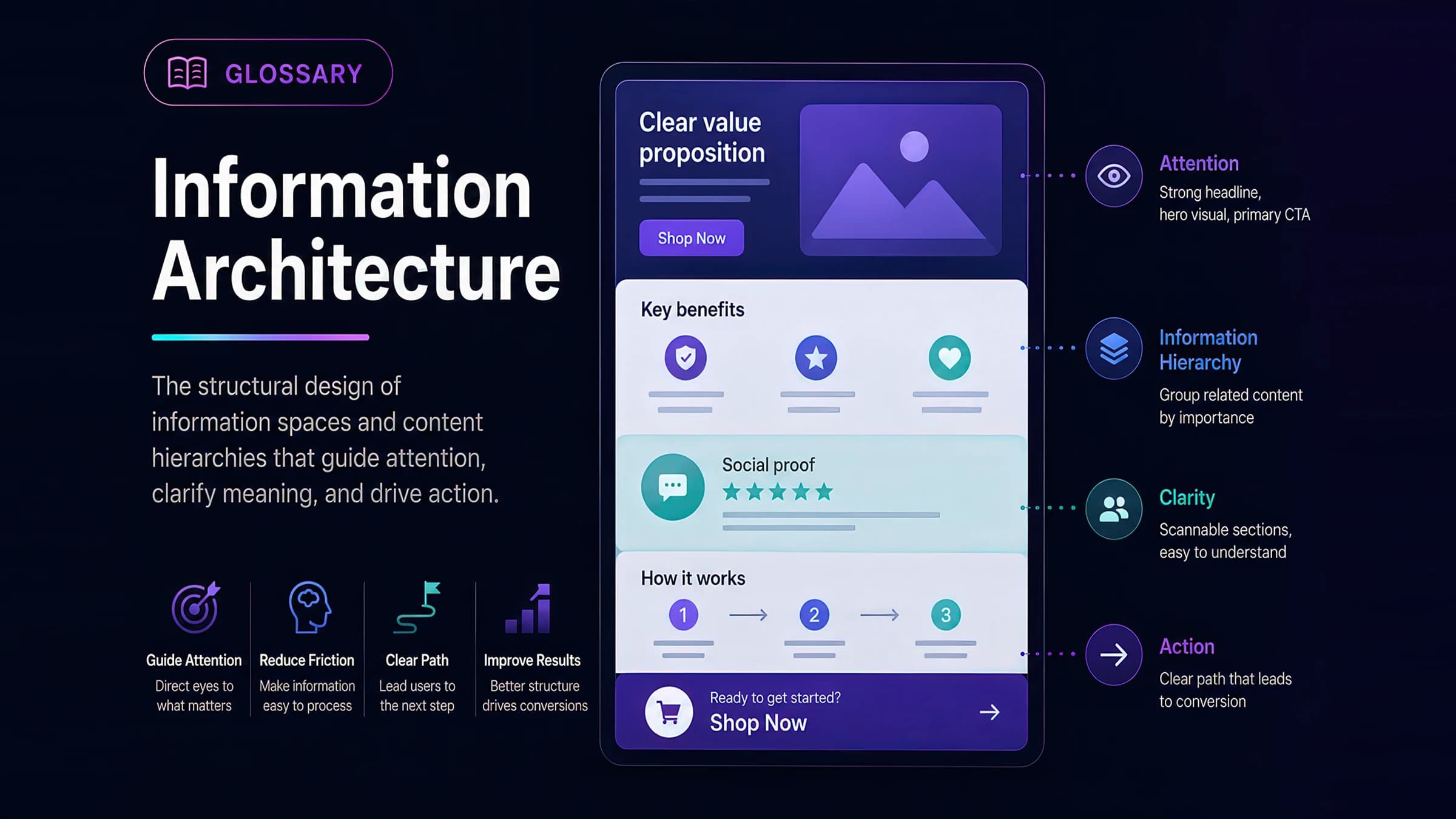
The structural design of information spaces and content hierarchies in digital advertising.
Definition

Information Architecture (IA) is the systematic organization and structuring of content elements within digital advertising assets to optimize user comprehension and conversion paths. It encompasses the strategic arrangement of text, visuals, and interactive elements to create intuitive information flows that guide users through the intended marketing narrative while maintaining cognitive clarity and reducing friction points. IA principles are crucial for both individual ad units and broader campaign ecosystems.

Examples

Structuring landing page content in F-pattern for natural eye movement flow

Organizing product features in progressive disclosure format for mobile ads

Implementing clear content hierarchies in multi-step ad carousels

Using breadcrumb navigation in dynamic product ads to maintain context

Structuring multi-variant ad tests to isolate IA impact

Supplemental Resources

Frequently asked questions

Common questions about Information Architecture, answered.

What is information architecture?
Information architecture (IA) is the practice of organizing, structuring, and labeling content so people can find what they need and understand where they are. It's the underlying organization of an experience — the grouping, ordering, and navigation of information. In marketing it shapes landing pages, interactive ad experiences, and any flow where content must be structured for clarity and easy navigation.
How does information architecture apply to ads?
Most directly to the destinations and richer formats: landing pages, collection-ad experiences, and interactive units, where content must be ordered so the visitor grasps the offer and moves toward action without confusion. Within a single ad frame, the closely related concept of visual hierarchy does the work; IA matters when there's a structured experience — multiple sections, steps, or navigation — to organize.
Why does information architecture affect conversion?
Because confused visitors leave. If a landing page or experience buries the key message, orders information illogically, or makes the next step hard to find, friction rises and conversion falls. Clear IA — logical grouping, an obvious path from value to action, and content ordered to answer questions in the right sequence — removes that friction and keeps visitors moving toward the goal.
What's the difference between information architecture and visual hierarchy?
IA is about structure and organization — how content is grouped, ordered, and labeled across an experience. Visual hierarchy is about visual emphasis — how design directs the eye within a view to what matters most. IA decides what content goes where and in what order; visual hierarchy decides what stands out. Good design needs both: sound structure (IA) made instantly readable (hierarchy).
How do I improve information architecture for a landing page?
Lead with the core value and the action; order content to answer the visitor's questions in the sequence they arise (what is it, why it's for me, proof, how to act); group related information clearly; minimize competing paths and navigation that distract from the goal; and ensure the primary CTA is easy to find at the natural decision points. Test the flow with real users to find where structure causes confusion or drop-off.

Related Terms

Visual Hierarchy

Related term

creative, component

User Experience (UX)

Related term

general, parent

Conversion Rate Optimization (CRO)

Related term

general, similar

Landing Page Optimization

Related term

general, component